


Table of Contents
- 1.Where Tubular Products Are Used in Offshore Wind
- 2.EN 10210 vs EN 10219 Hollow Sections
- 3.Grade Selection: S355J2H to S460
- 4.Offshore Wind Tubulars: When LSAW Becomes Relevant
- 5.Fatigue, Welding and NDT
- 6.Certification and Delivery Requirements
- 7.How to Specify an Offshore Tubular Package
- 8.Frequently Asked Questions
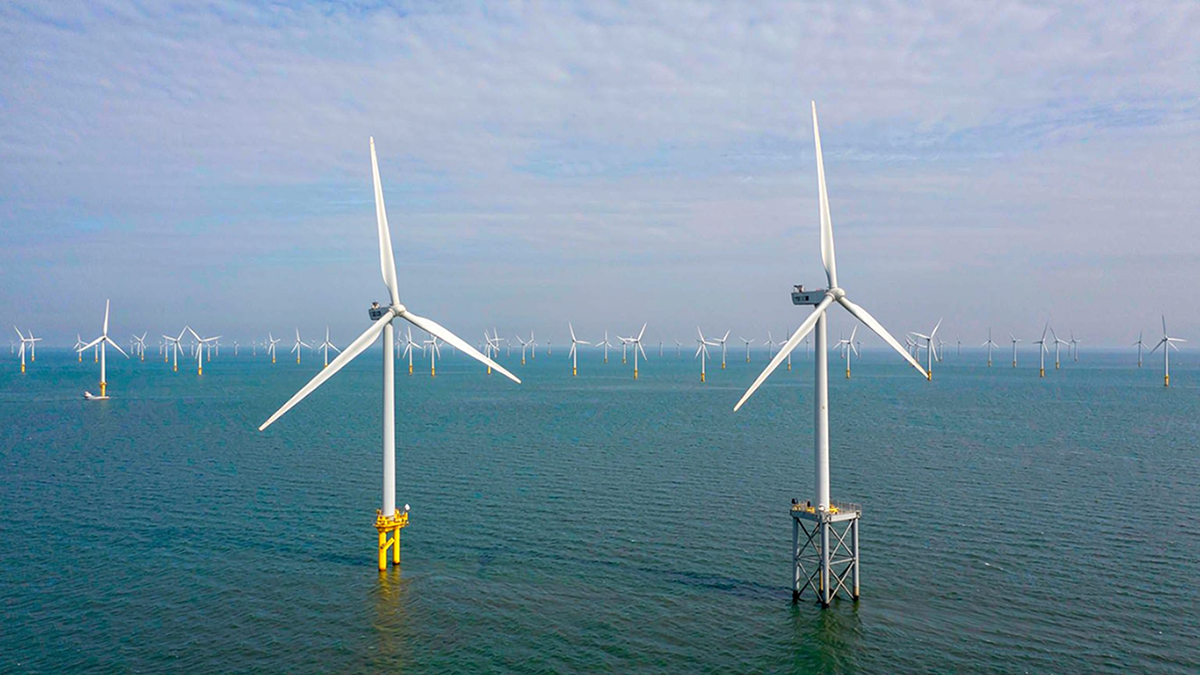
Offshore wind structures use a combination of tubular products rather than a single type of steel section. Structural hollow sections manufactured to EN 10210 or EN 10219 can be used for a range of structural and secondary members, while large-diameter welded tubulars manufactured by processes such as LSAW (Longitudinal Submerged Arc Welding) are commonly considered for larger structural members.
There is an important distinction between these terms. EN 10210 and EN 10219 are product standards for structural hollow sections, while LSAW describes a manufacturing process. They therefore should not be treated as three equivalent standards.
For an offshore wind project, the appropriate product route depends on the member geometry, required steel grade, service temperature, loading, fatigue design, welding requirements, inspection level and project specification.
This guide explains how EN 10210, EN 10219 and LSAW tubulars can fit into offshore wind and heavy-engineering applications, with particular attention to S355J2H, higher-strength grades, fatigue, welding, NDT and certification.
1. Where Tubular Products Are Used in Offshore Wind
Offshore wind foundations contain both major load-carrying members and smaller structural components. The appropriate tubular product depends on the design and manufacturing requirements of each member.
|
Application |
Possible tubular solution |
Main considerations |
|
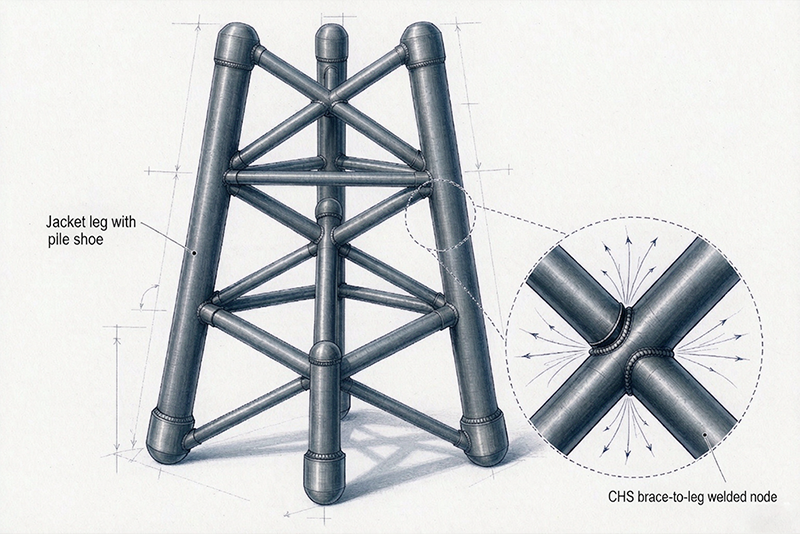
Jacket legs |
Large welded tubulars, including LSAW where applicable |
Diameter, wall thickness, fatigue and connections |
|
Jacket braces |
Structural hollow sections or large welded tubulars |
Member size, fatigue, connection design and fabrication |
|
Monopile primary tubulars |
Large-diameter welded tubulars |
Plate properties, forming, welding and structural requirements |
|
Transition-piece structures |
EN 10210, EN 10219 or larger welded tubulars depending on design |
Geometry, fabrication and project specification |
|
Internal platforms and frames |
EN 10210 / EN 10219 hollow sections |
Fit-up, dimensions and fabrication |
|
J-tubes and cable supports |
EN 10210 / EN 10219 or other specified tubular products |
Geometry, corrosion protection and project requirements |
|
Ladders and handrails |
EN 10219 / EN 10210 hollow sections |
Dimensions, surface condition and corrosion protection |
|
Floating-foundation braces |
EN 10210, EN 10219 or welded tubulars depending on design |
Cyclic loading, fatigue and structural capacity |
|
Large floating-foundation members |
Large welded tubulars where required |
Diameter, wall thickness and fabrication |
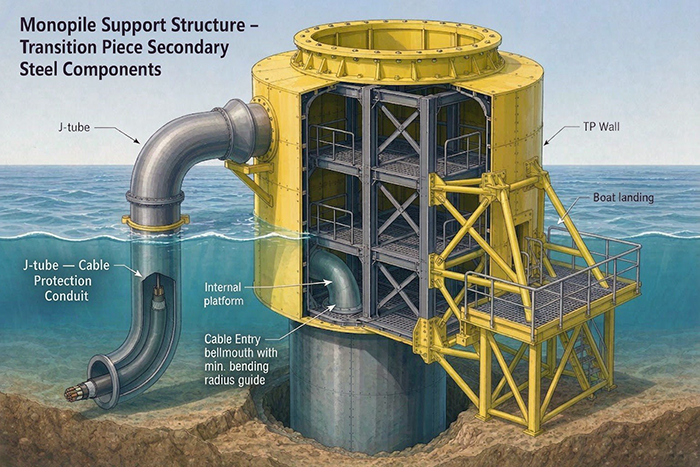
A single offshore wind project can use several tubular production routes.
For example, a jacket may use large welded tubulars for major structural members while EN 10210 or EN 10219 hollow sections are used for smaller frames, platforms and other structural components.
The important point is that the application alone does not determine the product standard. Section dimensions, material properties, structural design, fabrication requirements and the project specification all need to be considered.
In short: EN 10210 covers hot-finished structural hollow sections, EN 10219 covers cold-formed welded structural hollow sections, and LSAW is a longitudinal welding process used in the manufacture of welded tubulars. Offshore wind projects may use different combinations depending on the structural requirements.
2. EN 10210 vs EN 10219 Hollow Sections
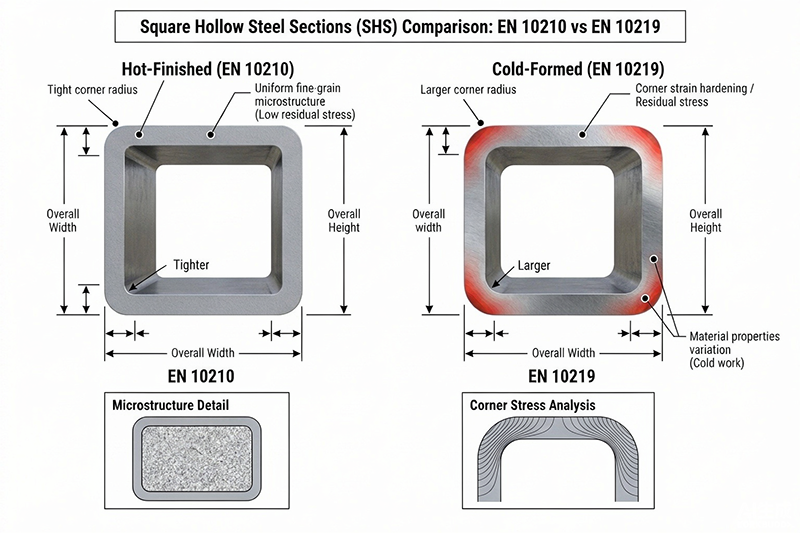
The main distinction between EN 10210 and EN 10219 is the manufacturing condition of the finished hollow section.
EN 10210 covers hot-finished structural hollow sections. The product may be formed at elevated temperature or produced by a route involving cold forming followed by an appropriate heat treatment, provided the finished product satisfies the requirements of the applicable standard.
EN 10219 covers cold-formed welded structural hollow sections. The section is formed from strip or plate and closed by a longitudinal weld before sizing and finishing.
These manufacturing conditions can influence material behavior, corner properties, residual stresses and the way a section performs during fabrication.
|
Characteristic |
EN 10210 |
EN 10219 |
| Product | Hot-finished structural hollow section | Cold-formed welded structural hollow section |
| Section types | CHS, SHS and RHS | CHS, SHS and RHS |
| Manufacturing condition | Hot-finished, including qualifying heat-treatment routes where applicable | Cold-formed and welded |
| Corner condition | Material condition influenced by the hot-finishing route | Local cold-forming effects may occur in corners |
| Residual stress | Can be reduced through the applicable finishing or heat-treatment route | Residual stresses associated with cold forming and welding may remain |
| Dimensions and tolerances | EN 10210-2 | EN 10219-2 |
| Typical use | Structural and engineering applications according to design requirements | Structural and engineering applications according to design requirements |
Neither standard should be described as universally better.
A designer may select EN 10210 because of the specified hot-finished material condition or because it fits the required structural and fabrication requirements. EN 10219 can be attractive where its available dimensions, material grades and manufacturing route meet the project requirements.
The final selection should be based on the design calculation, applicable standard and project specification.
What about fatigue?
Fatigue performance cannot be determined from the product standard alone.
For welded offshore structures, fatigue behavior can be affected by:
stress range
load spectrum
connection geometry
weld detail
stress concentration
weld toe condition
fabrication quality
misalignment
NDT
weld improvement treatment
environmental conditions
A hot-finished hollow section may have advantages associated with its material condition, but EN 10210 should not automatically be assigned a higher fatigue class than EN 10219.
Likewise, selecting a higher-strength steel grade does not automatically increase the fatigue category of a welded detail.
Fatigue assessment should follow the design standard and project methodology applicable to the offshore structure. DNV-RP-C203 is one commonly referenced document for fatigue assessment of offshore steel structures.
3. Grade Selection: S355J2H to S460
Steel grade selection normally starts with the required yield strength, impact toughness, service temperature, weldability and structural design.
S355J2H is an important structural hollow-section grade for applications where its specified strength and impact requirements meet the design basis.
The designation can be understood as:
S — structural steel
355 — nominal minimum yield strength for the applicable thickness range
J2 — specified impact toughness category
H — hollow section
The actual mechanical and impact requirements should always be checked against the applicable product standard, grade and thickness.
Common grade families
|
Grade family |
EN 10210 |
EN 10219 |
Typical consideration |
|
S235JRH |
✓ |
✓ |
General structural applications |
|
S275J2H |
✓ |
✓ |
General structural applications |
|
S355J2H |
✓ |
✓ |
Structural applications requiring a higher strength level |
|
S355K2H |
✓ |
✓ |
Applications requiring higher specified impact energy |
|
S355NH / NLH |
✓ |
✓ |
Lower-temperature service where specified |
|
S420NH / NLH |
✓ |
✓ |
Higher-strength applications |
|
S420MH / MLH |
— |
✓ |
Higher-strength cold-formed hollow sections |
|
S460NH / NLH |
✓ |
✓ |
Higher-strength applications |
|
S460MH / MLH |
— |
✓ |
Higher-strength cold-formed hollow sections |
The exact availability of a grade depends on the applicable standard, dimensions, thickness and manufacturer’s qualified production range.
J2, K2 and low-temperature requirements
Impact toughness should be matched to the design service temperature.
For example, J2 and K2 represent different specified impact-energy requirements at the relevant test temperature. If the design temperature is lower than the temperature covered by the selected grade, the project may require a different grade or supplementary impact testing.
Fine-grain grades with N or NL designations may be considered where the applicable standard and project specification require lower-temperature toughness.
The important point is that grade selection should be based on the actual design temperature and project requirements rather than simply choosing the lowest-temperature grade available.
Higher-strength grades
S420 and S460 grades may be considered when higher structural strength can provide a useful design benefit.
However, higher yield strength does not automatically allow a proportional reduction in wall thickness.
The member may still be controlled by:
fatigue
local buckling
global buckling
connection capacity
serviceability
weld design
fabrication requirements
impact toughness
For welded structures, the welding procedure also needs to be suitable for the selected grade and thickness.
Carbon equivalent and weldability
Higher-strength steels can require closer control of chemical composition and welding procedures.
Carbon equivalent, material thickness, preheating, heat input and cooling conditions may all affect welding practice.
For offshore fabrication, the applicable WPS/PQR and project welding specification should govern the welding procedure. The material grade should therefore be evaluated together with the fabrication process rather than considered independently.
4. Offshore Wind Tubulars: When LSAW Becomes Relevant
LSAW is particularly relevant to the manufacture of large welded tubulars.
The process starts with steel plate that is formed into a tubular shape and joined along the longitudinal seam using submerged arc welding. The actual manufacturing route and equipment depend on the producer and product requirements.
Monopile applications
Large monopile components require substantial tubular dimensions and are manufactured using large-diameter welded tubular production routes.
LSAW is one established process for producing large welded tubulars, but it should not be treated as the only possible manufacturing route.
The appropriate production method depends on factors such as:
required diameter
wall thickness
plate dimensions
steel grade
forming equipment
welding procedure
production capacity
project qualification requirements
Smaller components associated with monopile structures may use structural hollow sections when the required dimensions and properties fall within the applicable product and manufacturing range.
Jacket structures
Jackets typically contain legs, braces, nodes and secondary structures.
Large members may require welded tubulars manufactured from plate, including LSAW products where appropriate. Smaller members may be supplied as EN 10210 or EN 10219 hollow sections.
For fatigue-sensitive members, the tubular product should be considered together with the connection design, weld details and fabrication requirements.
Floating wind foundations
Floating concepts such as semi-submersible, spar and tension-leg platforms use tubular structural members with different load and fabrication requirements.
Depending on the design, these members may be supplied as structural hollow sections or large welded tubulars.
The selection process generally considers:
section size → grade → toughness → structural loading → fatigue → welding → NDT → certification
There is no single tubular standard that applies to every member of every floating-foundation concept.
Hollow sections vs LSAW tubulars
|
Requirement |
EN 10210 |
EN 10219 |
LSAW tubular |
| CHS |
✓ |
✓ |
✓ |
| SHS |
✓ |
✓ |
— |
| RHS |
✓ |
✓ |
— |
| Hot-finished hollow sections |
✓ |
— |
— |
| Cold-formed welded hollow sections |
— |
✓ |
— |
| Large-diameter welded tubulars |
Subject to applicable range |
Subject to applicable range |
✓ |
| Heavy-wall tubulars |
Subject to applicable range |
Subject to applicable range |
✓ |
| Jacket members |
Possible depending on size and design |
Possible depending on size and design |
Possible where applicable |
| Monopile-type tubulars |
Generally outside conventional hollow-section applications at very large sizes |
Generally outside conventional hollow-section applications at very large sizes |
Commonly considered for large welded tubular production |
| Fatigue-sensitive structures |
Design dependent |
Design dependent |
Design dependent |
The comparison should not be interpreted as a universal application rule. The final tubular route depends on the required geometry, material condition, structural design and project specification.
A simplified LSAW manufacturing route
A typical LSAW tubular production sequence may include:
Plate inspection → edge preparation → forming → longitudinal submerged arc welding → weld inspection → sizing/expansion → dimensional inspection → final NDT and certification
The exact sequence can vary according to the manufacturing process and product specification.
For offshore applications, quality control extends beyond the weld. Input plate properties, heat-number traceability, forming accuracy, welding parameters, weld integrity, diameter, wall thickness, roundness and straightness all need to be controlled.
For traceability, the relationship between the input plate and finished tubular should be maintained through production and inspection records.
For fatigue-sensitive tubular members, the location and orientation of the longitudinal seam may also need to be coordinated with fabrication and connection requirements where specified by the project
5. Fatigue, Welding and NDT
Offshore wind structures experience repeated loads from wind, waves, current and turbine operation. The number and magnitude of stress cycles depend on the structure and operating conditions.
For this reason, fatigue assessment focuses on the complete structural detail rather than the steel grade alone.
Weld geometry
Important factors can include:
weld toe geometry
local stress concentration
member intersection
weld profile
misalignment
weld discontinuities
connection geometry
fabrication tolerances
If a fatigue design assumes weld-toe grinding or another weld improvement treatment, the fabrication procedure needs to produce the specified condition consistently.
Longitudinal weld inspection
For welded EN 10219 hollow sections and welded EN 10210 products, the longitudinal seam is part of the manufacturing process.
For LSAW tubulars, the longitudinal SAW seam is likewise an important inspection area.
Depending on the applicable standard and project requirements, inspection may include:
visual inspection
ultrasonic testing
dimensional inspection
mechanical testing
impact testing
supplementary NDT
weld inspection
The exact inspection method, extent and acceptance criteria should be defined in the applicable standard, purchase specification and ITP.
CTOD and through-thickness properties
Some offshore projects may require supplementary testing for critical applications.
Depending on the design and specification, this can include:
CTOD testing
additional low-temperature impact testing
through-thickness properties
supplementary weld testing
enhanced NDT
project-specific acceptance criteria
These requirements should not be assumed to apply to every EN 10210, EN 10219 or LSAW product. They need to be agreed before production.
6. Certification and Delivery Requirements
An offshore tubular supply package normally includes more than the physical product. Material documentation, inspection records and traceability should be agreed before manufacturing begins.
EN 10210 and EN 10219
The purchase specification should identify:
product standard and edition
steel grade
CHS, SHS or RHS dimensions
wall thickness
length
dimensional tolerances
impact requirements
surface requirements
weld requirements
NDT requirements
marking
heat-number traceability
inspection documentation
LSAW tubulars
For large welded tubulars, the specification should cover both the input plate and finished tubular.
Typical items include:
plate standard
plate grade
plate thickness
tubular diameter
wall thickness
forming method
welding procedure
welding consumables
WPS/PQR
weld NDT
dimensional tolerances
roundness
straightness
impact testing
traceability
repair requirements
third-party inspection where specified
A plate standard such as EN 10225 should not be confused with the finished tubular specification. EN 10225 addresses offshore structural steel products such as plate, while the finished welded tubular may be subject to additional manufacturing and project requirements.
EN 10204 3.1 and 3.2
EN 10204 3.1 provides manufacturer-certified inspection documentation.
3.2 involves additional validation by an authorized inspection representative according to the agreed inspection arrangement.
Either level may be specified depending on the purchaser’s requirements and project documentation.
Third-party inspection can involve organizations such as DNV, Bureau Veritas or Lloyd’s Register when required by the contract or project.
CE and EN 1090
CE-marking and construction-product documentation depend on the product, intended use and applicable European conformity requirements.
Where applicable, project documentation may include a Declaration of Performance, Factory Production Control documentation and requirements associated with EN 1090.
These requirements should be established from the project’s conformity assessment route rather than assumed solely because the material is manufactured to EN 10210 or EN 10219.
7. How to Specify an Offshore Tubular Package
An offshore tubular RFQ normally needs more information than:
OD × WT × Length × Grade
A useful enquiry should define the product route and the quality requirements around it.
1. Identify the application
State whether the tubular is intended for:
jacket legs
jacket braces
monopile structures
transition-piece structures
floating-foundation members
platforms
J-tubes
ladders
cable supports
other heavy-engineering structures
2. Confirm the product route
Specify whether the required product is:
EN 10210 hot-finished hollow section
EN 10219 cold-formed welded hollow section
large welded tubular such as an LSAW product
Where the production route is not predetermined, the supplier can review the geometry and project specification before recommending an appropriate manufacturing route.
3. Define the grade and temperature requirements
Provide the exact grade, thickness and required impact-testing temperature.
If the project has a low design temperature, state the required testing condition clearly.
4. Define fatigue requirements
For fatigue-sensitive members, provide the relevant design basis and identify whether the fatigue assessment assumes:
as-welded condition
weld-toe grinding
another weld improvement treatment
special NDT
a specific fatigue detail category
5. Define NDT requirements
State the inspection method, extent and acceptance criteria required by the project.
6. Confirm certification
Specify whether the package requires:
EN 10204 3.1
EN 10204 3.2
third-party inspection
approved ITP
supplementary testing
full heat-number traceability
CE/FPC documentation where applicable
7. Verify actual manufacturing capability
The product standard’s scope should not be confused with a manufacturer’s actual production capability.
Before placing an order, verify the supplier’s capability for the required:
CHS diameter
SHS/RHS dimensions
wall thickness
length
steel grade
manufacturing condition
welding process
NDT
inspection documentation
This is particularly important for offshore projects where several requirements need to be met simultaneously.
8.Frequently Asked Questions
Q:Which is better for offshore wind, EN 10210 or EN 10219?
A:Neither is universally better. EN 10210 covers hot-finished structural hollow sections, while EN 10219 covers cold-formed welded structural hollow sections. The appropriate choice depends on dimensions, material properties, structural loading, fatigue design, fabrication requirements and the project specification.
Q:What is the main difference between EN 10210 and EN 10219?
A:The main difference is the manufacturing condition. EN 10210 covers hot-finished structural hollow sections, while EN 10219 covers cold-formed welded structural hollow sections. Their material condition and forming history can differ, so the applicable design and project requirements should be considered when selecting between them.
Q:Can EN 10219 hollow sections be used in offshore wind?
A:Yes, where the required dimensions, grade, material properties, fabrication requirements and design conditions are satisfied. They may be considered for platforms, frames, supports, J-tubes and other structural applications. The final suitability needs to be confirmed against the project design and specification.
Q:Is EN 10210 better for fatigue-critical offshore structures?
A:Not automatically. Hot-finished sections can have a different residual-stress and material condition from cold-formed sections, but fatigue performance depends heavily on the welded detail, stress range, connection geometry and fabrication quality. The applicable fatigue design method should be used to assess the complete structural detail.
Q:When should LSAW tubulars be considered?
A:LSAW tubulars may be considered when the required diameter, wall thickness, length or overall geometry is better suited to large welded tubular production from plate. The actual manufacturing route should be selected according to the required dimensions, material, equipment and project specification.
Q:Are monopiles made from LSAW pipe?
A:Large monopile components are manufactured using large-diameter welded tubular production processes. LSAW is one possible route, but the actual manufacturing method depends on the monopile design, dimensions, plate characteristics, production equipment and project requirements.
Q:What is the difference between EN 10225 and LSAW?
A:EN 10225 is a product standard for offshore structural steel products such as plate, while LSAW describes a longitudinal submerged arc welding process used to manufacture welded tubulars. EN 10225 plate can be used as input material for a welded tubular when the applicable project requirements permit it, but the finished tubular has additional manufacturing and inspection requirements.
Q:What grades are commonly considered for offshore hollow sections?
A:S355J2H is an important structural grade, while S355K2H, S355NH/NLH and higher-strength S420/S460 grades may be considered when the design requires different impact toughness, lower-temperature performance or higher structural strength. Grade selection should follow the applicable standard and project design requirements.
Q:Is EN 10204 3.2 mandatory for offshore wind?
A:Not universally. The required inspection certificate depends on the contract, purchaser and project specification. EN 10204 3.1 may be sufficient for some orders, while 3.2 can be specified when additional independent inspection is required.
Q:What information should be included in an offshore tubular RFQ?
A:An RFQ should normally identify the product standard, grade, dimensions, wall thickness, length, impact requirements, tolerances, NDT, certification and delivery requirements. For LSAW tubulars, the specification should also address the input plate, welding procedure, weld inspection, dimensional requirements and traceability.
Offshore Tubular Supply Based on Your Project Specification
The right tubular solution is determined by more than OD × WT. Product standard, manufacturing route, steel grade, toughness, fatigue requirements, welding, NDT, tolerances and certification all need to be considered together.
We can support enquiries for EN 10210 hot-finished hollow sections, EN 10219 cold-formed welded hollow sections and large-diameter LSAW tubulars, subject to the required size, grade and project specification.
Send your MTO, drawing, technical specification or ITP with the required dimensions, grade, NDT and certification requirements. Our engineering team can review the requirements, identify the applicable tubular production route and prepare a technical compliance matrix and commercial offer.
Post time: Sep-01-2026


