


On a quotation, material list or steel-yard rack, two hollow sections can look almost identical.
For example, both may be marked:
SHS 200 × 200 × 10 mm, S355J2H
But one may be supplied to EN 10219 and the other to EN 10210.
The nominal dimensions and steel grade may match, but the products are not automatically interchangeable. The difference is more than a manufacturing detail. It can affect the sectional properties used in design, Eurocode buckling checks, welding details and fabrication requirements.
Short answer: EN 10219 covers cold-formed welded structural hollow sections, while EN 10210 covers hot-finished structural hollow sections. Before accepting a substitution, check the product standard, grade, sectional properties, buckling design and fabrication requirements.
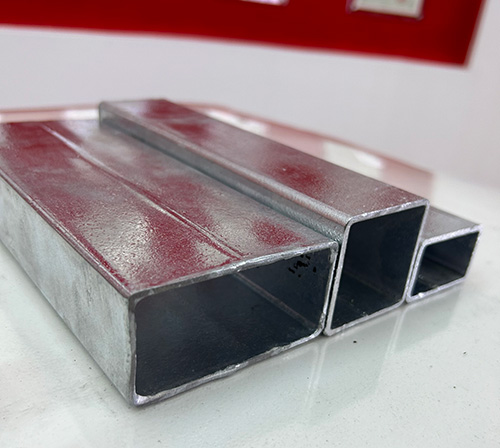
The Basic Difference
Both EN 10219 and EN 10210 cover familiar structural hollow-section shapes:
CHS — Circular Hollow Sections
SHS — Square Hollow Sections
RHS — Rectangular Hollow Sections
The main difference is the finished-product condition and the manufacturing route.
|
Item |
EN 10219 |
EN 10210 |
| Product type | Cold-formed welded structural hollow section | Hot-finished structural hollow section |
| Typical manufacturing route | Usually produced from steel strip that is cold-formed and longitudinally welded | Hot formed, or cold formed followed by the heat treatment required by the applicable product standard. |
| SHS/RHS nominal external corner radius used for sectional properties | 2.0t, 2.5t or 3.0t depending on wall thickness | 1.5t |
| Eurocode buckling treatment | Generally curve c in relevant common cases | Generally curve a for S235–S420 and curve a0 for S460 in relevant common SHS/RHS cases |
EN 10210 should not be treated as a synonym for seamless tube or simply as “hot-formed tube.” It is a product standard for hot-finished structural hollow sections. Depending on the manufacturing route and applicable technical delivery requirements, a section may be formed hot or cold-formed and subsequently heat treated to achieve the required finished-product condition.
Why the Corner Radius Matters
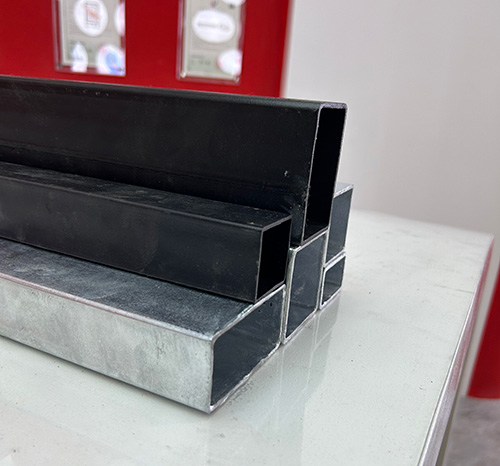
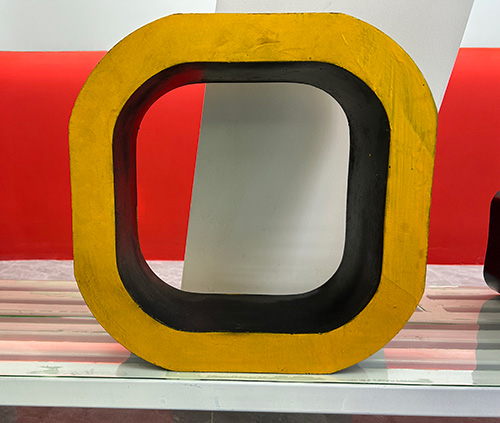
For CHS, the difference is less obvious from the outside. For SHS and RHS, corner geometry matters.
Under EN 10219, the nominal external corner radius used for sectional-property calculations is generally:
2.0t for wall thickness up to 6 mm
2.5t for wall thickness above 6 mm and up to 10 mm
3.0t for wall thickness above 10 mm
For the relevant EN 10210-2 sectional-property model, the nominal external corner radius for SHS and RHS is generally taken as approximately 1.5t.
It looks minor, but it affects the values used in design.
A smaller nominal corner radius retains more steel in the corner region of the sectional model. Therefore, EN 10210 and EN 10219 SHS/RHS sections with the same nominal dimensions may have different published values for:
Cross-sectional area
Second moment of area
Radius of gyration
Section modulus
For example, an SHS 150 × 150 × 8 mm has the same nominal outside dimensions under both standards. However, the EN 10210 sectional model uses a nominal 12 mm external corner radius, while EN 10219 uses 20 mm.
The EN 10210 model will generally produce higher nominal sectional properties. That does not automatically make it the better choice. It means the section table and design calculation must match the product actually being supplied.
Example: 150 × 150 × 8 mm SHS
Using the respective standard sectional-property models, the approximate values are:
|
Property |
EN 10210 model |
EN 10219 model |
|
Cross-sectional area |
~44.8 cm² |
~43.2 cm² |
|
Second moment of area |
~1,491 cm⁴ |
~1,412 cm⁴ |
These figures are based on the respective nominal geometric models. Actual products must comply with the dimensional tolerances and requirements of the applicable product standard.
Why Buckling Curves Differ
The difference can be important for columns, bracing members and other compression elements.
Cold forming can introduce residual stresses and local strain hardening, particularly around SHS and RHS corners. Hot-finished sections have a different finished-product condition. Eurocode 3 reflects this distinction when assigning flexural-buckling curves for common hollow-section cases.
|
Hollow Section Condition |
Typical Grade Range |
Buckling Curve |
|
Hot-finished hollow sections |
S235 to S420 |
Curve a |
|
Hot-finished hollow sections |
S460 |
Curve a0 |
|
Cold-formed hollow sections |
Relevant common cases |
Curve c |
For the same applicable calculation conditions, buckling curve c generally gives a lower design buckling resistance than curve a. The actual curve selection must follow the applicable edition of EN 1993-1-1 and the National Annex.
That does not mean EN 10210 is always stronger, or that EN 10219 cannot be used for columns. The final resistance still depends on the actual grade, section properties, effective length, buckling axis, relative slenderness, cross-section classification, loading and applicable partial factors.
Grade Names Are Not Enough
The steel grade alone does not identify the product standard.
Both EN 10210 and EN 10219 cover common structural hollow-section grades such as S235JRH, S355J2H and S355K2H, as well as fine-grain grades such as S355NH and S460NH.
The suffix H identifies a hollow-section steel grade. J0, J2 and K2 refer to Charpy impact-toughness requirements. N and NL indicate normalized or normalized-rolled fine-grain grades with specified impact properties, while M and ML are used for thermomechanically rolled grades. The exact requirements depend on the applicable product standard.
For example, these are different specifications:
S355NH, EN 10210-1
S355NH, EN 10219-1
The practical point is simple: S355NH or S355J2H alone is not a complete hollow-section specification. The RFQ, purchase order and inspection certificate should state both the steel grade and the product standard.
What J0, J2 and K2 Mean
For common non-alloy structural hollow-section grades, the suffixes are generally interpreted as follows:
|
Grade Suffix |
Charpy V-Notch Test Temperature |
Minimum Impact Energy |
|
JR |
+20°C |
27 J |
|
J0 |
0°C |
27 J |
|
J2 |
−20°C |
27 J |
|
K2 |
−20°C |
40 J |
K2 does not mean −40°C. It indicates a higher specified impact-energy requirement at the same nominal test temperature as J2.
Welding and Hot-Dip Galvanizing
EN 10219 hollow sections are widely welded in structural fabrication. Cold forming does not mean that the sections cannot be welded.
However, cold forming creates cold-worked zones in SHS and RHS corners. When welding is placed in or near these zones, the applicable design and fabrication requirements should be reviewed. EN 1993-1-8 includes specific provisions for welding within 5t of a cold-formed zone. Whether welding is permitted depends on conditions such as the corner radius-to-thickness ratio, cold-forming strain, steel condition and the loading situation. The applicable provisions should be checked for the actual detail.This can matter for heavily welded SHS/RHS connections, trusses, chord members and fabricated nodes.
Hot-dip galvanizing should also be considered during fabrication planning. Distortion can depend on section geometry, wall thickness, weld restraint and fabrication sequence. Where straightness, fit-up or tight dimensional tolerances are important, galvanizing requirements should be considered before fabrication.
Can EN 10219 Replace EN 10210?
Sometimes a substitution may be technically acceptable. It should not be approved simply because the size and grade are the same.
Suppose a drawing requires:
SHS 200 × 200 × 10 mm, S355J2H, EN 10210
A supplier offers:
SHS 200 × 200 × 10 mm, S355J2H, EN 10219
The dimensions and grade appear to match. However, the product standard is different, and the applicable corner geometry, sectional properties, buckling curve and fabrication considerations may also differ.
Before approving a substitution, check:
Product standard — Is the offered section EN 10210 or EN 10219?
Grade and delivery condition — Do the steel grade, toughness and delivery requirements meet the project specification?
Section properties — Are area, inertia, radius of gyration and section modulus based on the correct standard?
Dimensional tolerances — Do the supplied dimensions and geometrical tolerances meet the drawing and fabrication requirements?
Buckling design — Has the member been checked using the applicable Eurocode buckling curve?
Connections and fabrication — Are welding, galvanizing and connection details compatible with the selected product?
The same discipline should apply in reverse. Even where an EN 10210 section appears technically suitable, it should not replace an EN 10219 specification without confirming contractual requirements, dimensional tolerances, certification and the approved design basis.
How to Write a Clear RFQ
A vague enquiry creates avoidable technical and commercial risk.
Instead of writing:
SHS 200 × 200 × 10, S355
write a complete specification, for example:
SHS 200 × 200 × 10 mm, S355J2H, EN 10219-1, length _ m, quantity _ tonnes, EN 10204 3.1 certificate.
Where a hot-finished hollow section is required:
SHS 200 × 200 × 10 mm, S355J2H, EN 10210-1, length _ m, quantity _ tonnes, EN 10204 3.1 certificate.
A structural hollow-section RFQ should normally include:
Product standard
Steel grade
Section type, outside dimensions and wall thickness
Length and quantity
Delivery condition, where relevant
Coating or galvanizing requirement
Inspection-document requirement
Frequently Asked Questions
Q1:Is EN 10210 always seamless?
No. EN 10210 is a product standard for hot-finished structural hollow sections; it is not another name for seamless tube.
Depending on the manufacturing route and applicable technical delivery requirements, EN 10210 hollow sections may be produced by hot forming or by cold forming followed by heat treatment to achieve the required hot-finished metallurgical condition. The manufacturing method, weld requirements and inspection requirements should be confirmed in the RFQ, purchase order and mill certificate.
Q2:Are EN 10210 and EN 10219 dimensional tolerances the same?
Not necessarily.
EN 10210 and EN 10219 have their own requirements for dimensions, mass and geometrical tolerances. Even where SHS or RHS sections have the same nominal dimensions, do not assume that wall-thickness tolerance, outside-dimension tolerance, straightness, twist, corner geometry or mass tolerance will be identical.
Where fabrication accuracy is important, specify the required product standard, dimensional tolerances, length tolerance, straightness, twist and inspection requirements in the RFQ.
Q3:Can S355J2H replace S355NH?
Not automatically.
Both grades are associated with a 355 MPa nominal yield-strength level, but they belong to different grade families. S355J2H is commonly associated with Charpy V-notch impact toughness of 27 J at −20°C. S355NH is a fine-grain structural steel grade, and its delivery condition, chemical-composition requirements and impact-toughness requirements should be checked against the applicable product standard.
If a project specifies S355NH, an offer of S355J2H should not be accepted as an automatic substitute. The responsible engineer or project technical team should confirm material compliance, toughness requirements, delivery condition and applicable standard.
Q4:Is S355K2H better than S355J2H?
Not in every respect, but S355K2H has a higher specified impact-toughness requirement.
For common non-alloy structural hollow-section grades:
S355J2H generally requires 27 J at −20°C.
S355K2H generally requires 40 J at −20°C.
K2 may be appropriate where higher low-temperature impact toughness is required. The final material selection should still follow the project design temperature, structural application, thickness, welding requirements and project specification.
Q5:Can EN 10219 hollow sections be welded near the corners?
Yes, but the detail should be checked.
Cold forming creates cold-worked zones around SHS and RHS corners. EN 1993-1-8 includes specific provisions for welding in or near cold-formed zones, including requirements associated with welds located within 5t of such zones. The complete conditions in the standard must be checked for the actual detail.
This does not mean EN 10219 hollow sections cannot be welded. They are widely used in welded structural fabrication. However, heavily welded corners, truss nodes, chord members and RHS-to-RHS joints should be reviewed against the applicable design, welding and fabrication requirements.
Q6:What should be included in an RFQ for structural hollow sections?
At a minimum, include:
Product standard: EN 10219 or EN 10210
Steel grade: for example, S355J2H, S355K2H or S355NH
Section type: CHS, SHS or RHS
Outside dimensions and wall thickness
Length and length tolerance
Quantity
Delivery condition, where relevant
Surface condition, coating or galvanizing requirement
Inspection-document requirement, such as EN 10204 3.1
Any additional project requirements for testing, NDT, marking, packing or third-party inspection
For example:
SHS 200 × 200 × 10 mm, S355J2H, EN 10210-1, random lengths 10–12 m, quantity 80 MT, EN 10204 3.1 certificate, suitable for hot-dip galvanizing, external visual inspection required.
Conclusion
EN 10219 and EN 10210 may cover hollow sections with the same nominal dimensions and similar steel grades, but they are not automatically interchangeable.
EN 10219 covers cold-formed welded structural hollow sections, while EN 10210 covers hot-finished structural hollow sections. The difference can affect sectional properties, Eurocode buckling assumptions and fabrication requirements.
Before approving a substitution, verify the product standard, section properties, buckling design, dimensional tolerances and fabrication requirements.
Technical note: Always follow the edition of the standards named in the project specification. This article is a practical guide and does not replace the responsible engineer’s design verification, the adopted EN standard or the applicable National Annex.
Post time: Sep-24-2026


