


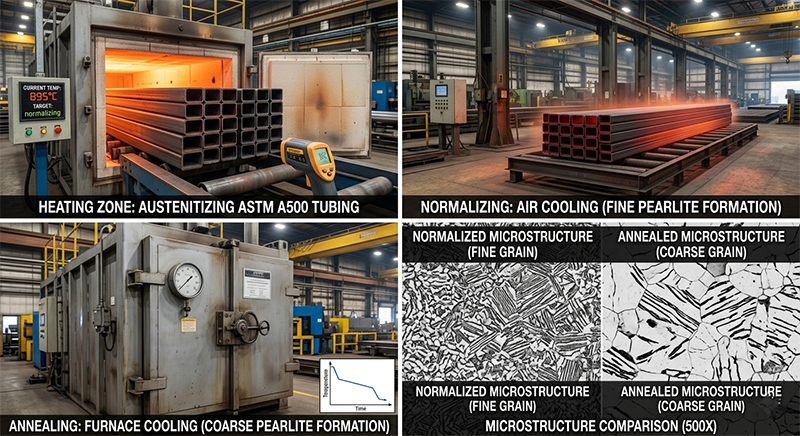
In the heavy-duty world of steel manufacturing, heat treatment is often called the “invisible heart” of the process. You can’t see it in the finished product with the naked eye, but you can certainly feel it when a pipe either stands strong under immense pressure or snaps under a sudden load. Among all thermal cycles, Normalizing and Annealing are the two pillars of metal modification.
However, there is a massive gap between “doing” heat treatment and “mastering” it. Today, we’ll dive into the mechanics of these processes and reveal how a breakthrough in thermal uniformity is redefining industry standards.
1. Annealing: The Art of Total Relaxation
Think of Annealing as a “deep tissue massage” for steel. When a pipe is formed—especially through cold-working—its internal grains become stretched, stressed, and incredibly hard. While hardness sounds good, it often comes with brittleness.
- The Process: We heat the steel pipe to its critical temperature and then do something that requires immense patience: we leave it in the furnace. The pipe cools down at a snail’s pace along with the furnace itself (Furnace Cooling).
- The Result: This slow journey allows the carbon atoms to rearrange into large, coarse grains. The steel reaches its softest possible state with maximum ductility.
- The Use Case: If you need a pipe that can be easily machined, bent into complex shapes, or flared without cracking, annealing is your go-to process. It’s about making the steel “obedient.”
2. Normalizing: Engineering the Perfect Balance
Normalizing is the “reset button” for steel’s molecular structure. It is designed to give the pipe a “normal,” uniform, and refined grain size, which is essential for structural integrity.
- The Process: The pipe is heated slightly higher than in annealing, but instead of staying in the furnace, it is pulled out to cool in still air.
- The Result: Because air cooling is faster than furnace cooling, the grains don’t have time to grow too large. You get a fine-grained, tough, and strong microstructure.
- The Use Case: This is the gold standard for structural pipes. It ensures that the pipe is strong enough to carry weight but tough enough to resist impact and vibration.
The Invisible Barrier: The Struggle for Thermal Uniformity
Here is the industry’s “dirty secret”: most factories struggle with Thermal Gradients.
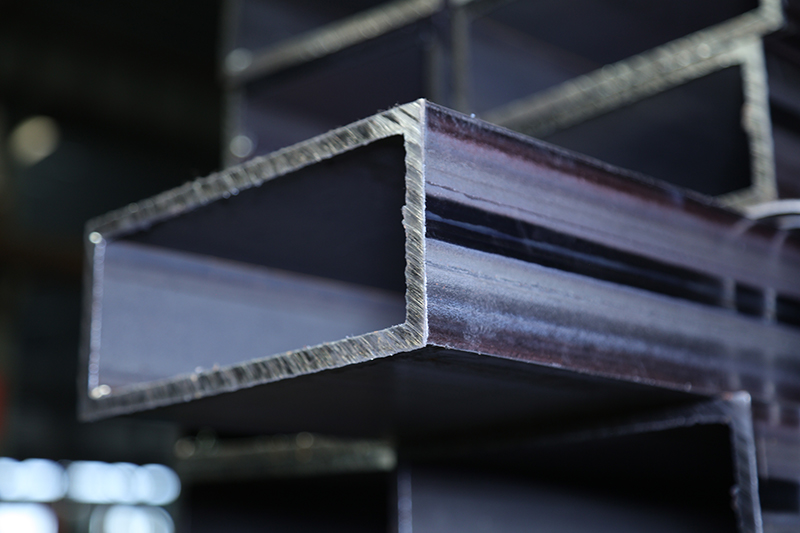
Imagine a massive square steel pipe inside a furnace. Even in the best conventional furnaces, “cold spots” are a nightmare. If the top of the pipe is at 920℃ while the bottom or the corners are at 890 ℃, the metallurgical transformation will be inconsistent. This leads to uneven grain structures—where one part of your pipe is strong and another part is unexpectedly brittle. This inconsistency is the primary cause of structural failure in the field.
Achieving perfect Thermal Uniformity—where every single millimeter of the pipe’s periphery and length reaches the exact same temperature at the exact same time—is a hurdle that many manufacturers simply cannot clear.
The Yuantai Derun Breakthrough: Engineering the Impossible
At Yuantai Derun, we didn’t want to settle for “industry average.” After years of intensive R&D and significant capital investment, we have successfully conquered the technical barrier of uneven heating.
Our proprietary Precision Temperature Control System is a game-changer. By utilizing multi-point atmospheric monitoring and advanced induction technology, we have achieved a level of thermal equilibrium that was previously thought impossible in large-scale production.
This isn’t just a minor improvement; it is a major technological breakthrough. By ensuring that every inch of the pipe undergoes an identical phase transformation, we produce steel pipes with a level of structural consistency that standard factories cannot match. This mastery of heat is the ultimate reflection of Yuantai Derun’s R&D strength—we don’t just heat steel; we refine it with scientific precision.
Comparison at a Glance: Normalizing vs. Annealing
| Metric | Annealing | Normalizing |
| Cooling Method | Furnace Cooling (Ultra-Slow) | Air Cooling (Moderate) |
| Microstructure | Coarse & Relaxed Grains | Fine & Uniform Grains |
| Mechanical Edge | Extreme Softness / Ductility | High Strength / Toughness |
| Production Time | Very Long (Costly) | Efficient & Standardized |
Final Thoughts: Which One Do You Need?
The choice between a normalized or annealed pipe depends entirely on your project’s final goal. If you are looking for a material that needs to withstand the brutal forces of a skyscraper or a bridge, the refined, high-strength grain of a normalized pipe is non-negotiable. If you are doing precision machining where the tool must glide through the metal, annealing is your answer.
Regardless of the choice, the thermal uniformity provided by Yuantai Derun ensures that whichever “personality” you choose for your steel, it will be consistent from one end of the pipe to the other.
Post time: Mar-06-2026


