


A 20mm square hollow section looks like a simple thing — a small square tube, 20 mm on each side. But once you start specifying it, the questions stack up. What wall thicknesses actually exist? How much does it weigh per metre? Which grade should you pick? And how do you order it without ending up with a batch that fails inspection?
This guide answers those questions for buyers, fabricators and engineers. The numbers here are kept honest: where a value depends on the standard, the mill or the tolerance class, we say so rather than quoting one figure and hoping it holds.
What is a 20mm square hollow section?
“SHS” stands for square hollow section. The “20mm” refers to the outside dimension — the tube measures 20 mm across each side. Wall thickness is a separate choice, and it is the number that changes a great deal: weight, stiffness, weldability and price all move with it.
Most 20mm square tube on the market is welded and cold-formed. In Europe it is commonly supplied to EN 10219. The hot-finished equivalent, EN 10210, also exists, but hot-finished supply at this small size is limited — thin walls at 20 × 20 mm are normally cold-formed, so it is worth checking availability before you specify hot-finished. In China, GB/T 6728 is the usual standard (the 2025 edition, in force since March 2026). In North America, ASTM A500 covers cold-formed welded and seamless carbon steel structural tubing.
20mm SHS vs 20mm round pipe vs 20mm seamless tube
Three comparisons come up again and again.
Square versus round. At the same nominal size, a square tube and a round tube are not interchangeable. A square section has different section moduli about its two principal axes, while a round tube behaves the same in every direction — useful when the load direction is not fixed. Square tube also gives you four flat faces, which makes welding, drilling and bolting more straightforward. Round tube can be cheaper to produce in very thin walls, which is why it still dominates some light-duty products.
Welded versus seamless. Nearly all 20mm square tube is welded (ERW or HFW) and then shaped. A true seamless square tube at this size is uncommon — it would start life as a seamless round tube and be reshaped afterwards. If a drawing calls for “seamless square”, it is worth confirming that it is genuinely available before you price the job. It is normally handled as a special order — either a seamless round tube reshaped, or a cold-drawn special section — and both the price and the lead time move noticeably.
20mm SHS standard dimensions and wall thickness
For a 20 × 20 mm section, the wall thicknesses you will see most often are 1.0, 1.2, 1.5, 1.6 and 2.0 mm. Anything thinner becomes more demanding to weld consistently, because it depends more on the process, the fixturing and the operator; anything much thicker starts to make the section look more like bar stock than tube.
| Outside size (mm) | Common wall thickness (mm) | Outer corner radius | Typical length |
| 20 × 20 | 1.0, 1.2, 1.5, 1.6, 2.0 | about 2 × wall thickness | 6 m typical |
Two details matter here. First, the corner radius: square tube does not have perfectly sharp corners. Cold-formed sections usually carry an outer radius of roughly twice the wall thickness, and the standard that governs your order sets the permitted range around that figure — which is also one reason weight tables in circulation do not all agree. If your design needs a tight corner, it is worth looking at sharp-angle tube instead. Second, the length: 6 m is the most common mill and export length, with 5.8 m and 12 m also supplied — stock and project lengths vary by region, so confirm what your supplier carries. Custom lengths are possible, though they usually affect lead time.
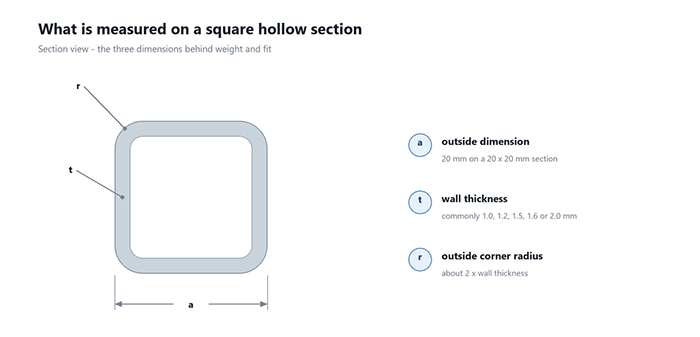
Tolerances are set by the applicable standard. EN 10219-2, for example, covers outside dimensions, wall thickness, corner radius, straightness and twist. The exact figures depend on the class and the product, so it is safer to confirm them against the standard you are buying to rather than assuming a number from another project.
20mm square hollow section weight per meter
Weight is where most enquiries start, so here is the method rather than just a figure.
For a square tube, the theoretical mass per metre is:
W (kg/m) = 0.00785 × 4t(a − t)
where a is the outside side in millimetres, t is the wall thickness in millimetres, and 0.00785 is the density of carbon steel (7.85 g/cm³) expressed so the units work out. This is the simple square-corner form: four flat walls, with the rounded corners left out of the sum. It is the version you can check by hand in a few seconds, and it deliberately avoids the corner-radius convention, which is where published tables tend to diverge. The result sits at the top of the range.
Using that formula, a 20 × 20 mm section works out as follows:
| Wall thickness (mm) | Theoretical mass, square corners (kg/m) | Mass of a 6 m length (kg) |
| 1.0 | 0.60 | 3.58 |
| 1.2 | 0.71 | 4.25 |
| 1.5 | 0.87 | 5.23 |
| 1.6 | 0.92 | 5.55 |
| 2.0 | 1.13 | 6.78 |
These are theoretical weights, calculated from nominal dimensions with the corners left square, so they read at the top of the range. A table that deducts the rounded corners will come out lower — by roughly 3% at 1.0 mm and about 7% at 2.0 mm, with the gap narrowing as the section gets larger. Wall thickness is delivered inside a tolerance as well, so the weight of a bundle will differ from the calculated figure. Treat the table as a planning figure rather than a shipping weight.
One method is worth calling out, because it turns up in a lot of spreadsheets. Some calculators work out the perimeter first and then treat the tube as a round pipe of the same perimeter — sometimes written as (perimeter ÷ π − wall) × wall × 0.0246615. It is quick and it is fine for a rough estimate, but it reads a percent or two heavier than the formula above, and the gap grows as the section gets smaller and the wall gets thicker. The reason is simple geometry: of all shapes with a given perimeter, a circle encloses the most area, so pretending a square tube is a circle of equal perimeter overstates the steel in the section. If you are comparing two quotes, make sure both sides are using the same method.
If you regularly work between metric and imperial sizes, the millimetre-to-inch chart is a useful companion to this table. For a wider view of how hollow sections are measured and weighed, see our hollow section weight reference.
 0
0
Turning weight per metre into a shipment figure
Once you have the figure for one metre, the rest is arithmetic:
- Metres per bundle = bundle length × number of tubes
- Bundle weight ≈ weight per metre × metres per bundle
- Shipment weight ≈ the sum of the bundles, plus a small allowance for strapping and any end protection
A worked example. Two hundred lengths of 20 × 20 × 1.5 mm, each 6 m long, is 1,200 m of tube. At 0.87 kg/m that comes to about 1,045 kg — just over a tonne. Three hundred lengths would be around 1.57 t. The packing adds a little on top, so it is worth leaving a margin when you book space or ask for a freight rate.
The useful thing about a small section is how many metres it takes to make a tonne. Because a 20mm square hollow section is light, a single order often mixes several sizes and wall thicknesses to fill a load — normally cheaper per tonne than shipping one small size on its own.
Available materials and grades
The grade you choose sets the yield strength, and that in turn decides how much load the tube can carry. For 20 mm square tube, a handful of grades cover most work:
- EN 10219 / EN 10210: S235JRH, S275J0H and S355J2H are the common structural grades. The number is the minimum yield strength in MPa, so S355 is stronger than S235.
- GB/T 6728-2025: Q235B and Q355B are the usual choices in the Chinese market.
- ASTM A500: Grade B and Grade C are the grades normally supplied for square and rectangular tubing, and Grade D is also available (it is heat-treated). Grade A still appears on older drawings, but it is no longer listed in the current edition of the standard, so it is worth checking before you price a job that calls for it.
A word of caution on small sections: with a 1.0 mm wall, the tube’s capacity is limited as much by local buckling and handling damage as by the steel’s yield strength. Moving up a grade does not automatically fix a section that is too thin for the span — sometimes the answer is simply a bigger tube.
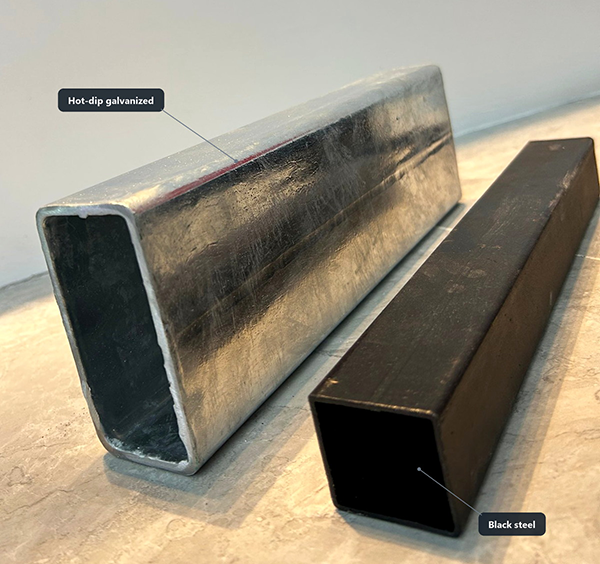
Surface finish is a separate decision from grade. Bare (black) tube is the default. Pre-galvanized tube has a zinc coating applied to the strip before forming. Hot-dip galvanized tube gets its coating after fabrication and generally gives thicker, longer-lasting protection. The two are not the same, and the choice affects both cost and corrosion life. Painted and oiled finishes are also available; the galvanized pipe range covers the coated options in more detail.
Typical applications
At this size, a 20mm square hollow section tends to appear where lightness matters more than raw load capacity:
- Furniture and shelving frames
- Handrails, balustrades and gate infills
- Fencing and greenhouse structures
- Machine guards and light equipment frames
- Racking, trolleys and display stands
- Automotive and general engineering parts
It is also a common choice for prototypes and one-off frames, because it cuts and drills easily with hand tools and is easy to source in small quantities.
How 20mm square tube is made
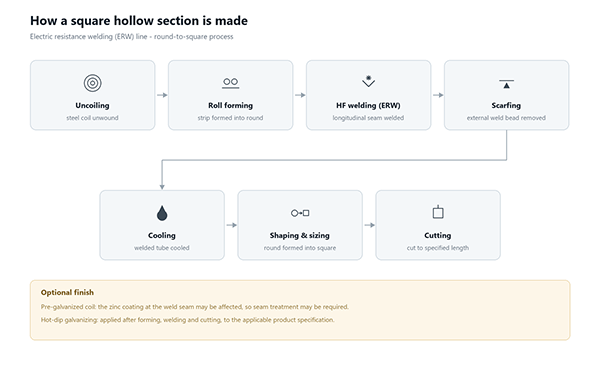
Knowing the process helps when you are comparing quotes. A strip of steel is uncoiled, formed into a round shape by a series of rolls, and the seam is welded — either by electrical resistance (ERW) or high-frequency welding (HFW). The welded round tube then passes through shaping rolls that turn it into a square section, and the corners are formed to the required radius. Finally the tube is sized, straightened and cut to length.
Because the corners are formed rather than cut, the wall thickness at the corners can vary slightly from the wall in the middle of a face. This is normal, and it is one reason a mill test certificate and a dimensional check are worth asking for on a structural order.
How to buy 20mm SHS from China
If you are sourcing from overseas, a few practical points save time later.
Minimum order. Small sections pack a lot of metres into a container, so a full container can represent a substantial tonnage. Ask what the mill’s minimum is for your size and finish before you build a budget around a small trial order.
Lengths and cutting. 6 m is the most common mill and export length. If your product needs fixed cut lengths, ask whether cutting can be done at the mill — doing it at source often costs less than cutting on arrival, and it reduces waste.
Certification. For structural or regulated work, ask for a mill test certificate covering the standard your order is placed to — EN 10204 3.1 is a common format — and check that the grade and heat number match the delivery. For export projects, third-party inspection can usually be arranged before shipment.
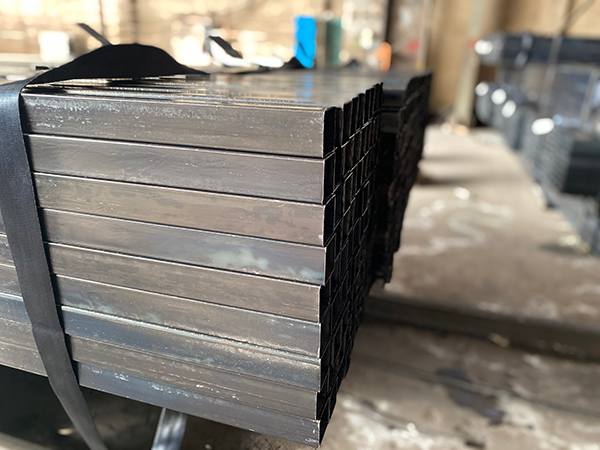
Surface and packing. Decide on bare, pre-galvanized or hot-dip galvanized early, because it affects lead time. Standard packing is bundles secured with steel strapping; end caps or plastic wrap can be added if the tube will sit in storage for a while.
Lead time. This varies with size, finish and order volume. It is worth confirming in writing rather than relying on a general figure quoted at the enquiry stage.
Yuantai Derun manufactures square and rectangular hollow sections in Tianjin, including small sizes such as 20 × 20 mm, and supplies both domestic and export markets. The wider range is set out on the square and rectangular steel hollow section page.
What to check when the tube arrives
A short inspection on delivery prevents most disputes later.
- Dimensions. Spot-check the outside size and wall thickness against the standard’s tolerance, not just against the nominal figure.
- Straightness and twist. Roll a length on a flat surface; a tube that rocks noticeably may be outside the straightness or twist tolerance.
- The weld seam. Check that the seam is continuous and that there are no obvious splits or pinholes.
- Surface. Look for rust, scuffs or coating defects, particularly on galvanized stock, where damage to the coating is the usual complaint.
- Documentation. Match the heat numbers on the bundle to the mill certificate.
None of these replace a proper inspection regime, but they catch the obvious problems before the material reaches the production line.
FAQ
How much does a 20×20 square tube weigh per metre?
It depends on the wall thickness. A 1.5 mm wall works out at about 0.87 kg/m, and the range from 1.0 mm to 2.0 mm runs from roughly 0.60 kg/m to 1.13 kg/m. These are theoretical figures based on nominal dimensions with the corners left square, so treat them as a planning guide rather than a shipping weight.
How close is the table weight to the actual weight of a delivery?
It is a calculation from nominal dimensions, not a weighed figure, so expect a small difference. Wall thickness is delivered inside a tolerance, and packing adds a little on top. Use the table for planning and estimating; the weight of a delivery is established by weighing.
What is the difference between 20mm SHS and 25mm SHS?
The outside dimension. A 25 × 25 mm section is larger, so it is stiffer and heavier for the same wall thickness. Moving up a size is often a simpler fix for a stiffness problem than changing the grade.
What wall thickness is standard for 20×20 SHS?
There is no single standard thickness — 1.0, 1.2, 1.5, 1.6 and 2.0 mm are all common. The right choice comes from the load case and the welding process, not from habit.
Can 20mm square tube be galvanized?
Yes. Both pre-galvanized and hot-dip galvanized versions are available. Hot-dip generally gives thicker, longer-lasting protection, but it adds a processing step and can affect lead time.
What length does 20mm SHS come in?
6 m is the most common mill and export length, with 5.8 m and 12 m also supplied. Custom cut lengths can often be arranged.
Is 20mm SHS the same as 20mm box section?
In everyday use, yes — “box section” and “square hollow section” describe the same product. Some suppliers reserve “box” for the larger sizes, but there is no formal difference.
Ordering 20mm square hollow section
If you know the size, wall thickness, grade, finish and quantity you need, the fastest route is a written enquiry with those details. If you are still working out the wall thickness, send us the application and the load or span, and we can suggest a section that fits.
Request a quote or ask for the current specification and weight sheet for 20 × 20 mm square hollow section.
{
“@context”: “https://schema.org”,
“@type”: “FAQPage”,
“mainEntityOfPage”: {
“@type”: “WebPage”,
“@id”: “https://www.ytdrintl.com/news/20mm-square-hollow-section-dimensions-weight-chart-buying-guide/”
},
“mainEntity”: [
{
"@type": "Question",
"name": "How much does a 20×20 square tube weigh per metre?",
"acceptedAnswer": {
"@type": "Answer",
"text": "It depends on the wall thickness. A 1.5 mm wall works out at about 0.87 kg/m, and the range from 1.0 mm to 2.0 mm runs from roughly 0.60 kg/m to 1.13 kg/m. These are theoretical figures based on nominal dimensions with the corners left square, so treat them as a planning guide rather than a shipping weight."
}
},
{
"@type": "Question",
"name": "How close is the table weight to the actual weight of a delivery?",
"acceptedAnswer": {
"@type": "Answer",
"text": "It is a calculation from nominal dimensions, not a weighed figure, so expect a small difference. Wall thickness is delivered inside a tolerance, and packing adds a little on top. Use the table for planning and estimating; the weight of a delivery is established by weighing."
}
},
{
"@type": "Question",
"name": "What is the difference between 20mm SHS and 25mm SHS?",
"acceptedAnswer": {
"@type": "Answer",
"text": "The outside dimension. A 25 × 25 mm section is larger, so it is stiffer and heavier for the same wall thickness. Moving up a size is often a simpler fix for a stiffness problem than changing the grade."
}
},
{
"@type": "Question",
"name": "What wall thickness is standard for 20×20 SHS?",
"acceptedAnswer": {
"@type": "Answer",
"text": "There is no single standard thickness — 1.0, 1.2, 1.5, 1.6 and 2.0 mm are all common. The right choice comes from the load case and the welding process, not from habit."
}
},
{
"@type": "Question",
"name": "Can 20mm square tube be galvanized?",
"acceptedAnswer": {
"@type": "Answer",
"text": "Yes. Both pre-galvanized and hot-dip galvanized versions are available. Hot-dip generally gives thicker, longer-lasting protection, but it adds a processing step and can affect lead time."
}
},
{
"@type": "Question",
"name": "What length does 20mm SHS come in?",
"acceptedAnswer": {
"@type": "Answer",
"text": "6 m is the most common mill and export length, with 5.8 m and 12 m also supplied. Custom cut lengths can often be arranged."
}
},
{
"@type": "Question",
"name": "Is 20mm SHS the same as 20mm box section?",
"acceptedAnswer": {
"@type": "Answer",
"text": "In everyday use, yes — “box section” and “square hollow section” describe the same product. Some suppliers reserve “box” for the larger sizes ,but there is no normal diffeence."
}
}
]
}
Post time: Oct-13-2026


