


Table of Contents
- · Engineering Reference Documents
- · Standard Overview
- · Key Technical Updates
- · Grade Equivalence Table
- · Technical Comparison (2017 vs. 2025)
- · Applications
- · Procurement Checklist
- · Frequently Asked Questions
- · Supplier Capability
- · Technical Support
GB/T 6728-2025 replaces the 2017 edition for cold-formed structural hollow sections in China, introducing updated requirements for fabrication, quality control, and standard compliance.
International projects require evaluation of material equivalency with widely used standards such as EN 10219 and ASTM A500. This guide provides downloadable engineering reference data, steel grade comparisons, and technical auditing benchmarks.
· Engineering Reference Documents
To facilitate technical compliance reviews and design audits, the official structural steel standard is available for engineering evaluation in multiple linguistic editions:
Official Source: [ GBT-6728-2025-Official-Chinese-Version-Standard-PDF ]
Bilingual Edition: [ GBT-6728-2025-Bilingual-Chinese-English-Reference-Guide ]
English Edition: [ GBT-6728-2025-English-Translation-Structural-Steel-Standard ]
· Standard Overview
GB/T 6728 was first issued in 2017 as the baseline standard for cold-formed hollow sections in China.
A revision process began in 2023 to improve fabrication compatibility and quality control systems. GB/T 6728-2025 was published in 2025 and takes effect in China from March 1, 2026.
· Key Technical Updates
The updated framework addresses specific steel performance factors to better match modern automated processing demands:
Higher Precision Requirements: Tailored specifically for automated fabrication and robotic welding lines.
Improved Dimensional Consistency: Minimizes assembly misalignments in modular and pre-engineered buildings.
Digital Compatibility: Seamless alignment with Building Information Modeling (BIM) data and digital manufacturing pipelines.
Enhanced Corrosion Protection: Upgraded hot-dip galvanizing assessment criteria for aggressive outdoor environments.
International Harmonization: Closer integration with global structural standards to reduce trade friction.
· Grade Equivalence Table
Example:Standard Positioning Table
|
Standard |
Region |
Type |
Application Focus |
|
GB/T 6728-2025 |
China |
Cold-formed welded hollow section |
Domestic + export projects |
|
Europe |
Cold-formed structural hollow section |
EPC / construction |
|
|
USA |
Cold-formed carbon steel tube |
Structural steel framing |
Technical Note: Equivalent grades shown below represent approximate mechanical property correspondence and should not be considered direct material substitutions without engineering review.
| Chinese Standard (GB/T 6728-2025) | European Equivalent (EN 10219) | US Equivalent (ASTM A500) | Yield Strength (MPa) | Mechanical & Engineering Characteristics | Typical Project Applications |
| Q235B | S235JRH | Grade A / B | ≥235 MPa | Baseline yield structural grade; verified for basic static loading criteria. | Light structural frameworks, solar mounting structures, and secondary bracing. |
| Q355B | S355J0H | Grade B / C | ≥355 MPa | Standard 0°C impact energy baseline; cross-referenced for standard global structural loading. | Logistics warehouses, steel workshops, prefabricated plants, and airport terminals. |
| Q355D / Q355E | S355J2H / S355K2H | Grade C (High Spec) | ≥355 MPa | Verified low-temperature impact performance (-20°C / -40°C); mandatory for dynamic sub-zero designs. | Low-temperature environments, coastal infrastructure, ports, bridges, and offshore facilities. |
· Technical Comparison (2017 vs. 2025)
For technical documentation audits, this comparative breakdown highlights the critical updates between the standard editions:
| Technical Item | GB/T 6728-2017 (Old) | GB/T 6728-2025 (New) | Key Difference & Engineering Impact |
| Laser Processing | Not included within code scope | Officially added with specific baselines | Guarantees material suitability for high-speed automated cutting and exact geometric fitment. |
| Thickness Tolerance | Traditional batch-based allowances | Revised Appendix B classifications | Standardizes thickness criteria, restricting negative tolerance risks in structural calculations. |
| Galvanizing Testing | General visual & weight inspection | Strict Section 8.3 re-inspection rules | Mandates systematic re-testing protocols to enhance QA compliance for outdoor rust prevention. |
| Digital Traceability | Limited or uncodified paperwork | Explicitly recommended batch tracing | Encourages automated verification, which reduces document verification time during site inspections. |
| Global Alignment | Moderate global compatibility | Improved harmonization with EN/ASTM | Matches global metallurgical testing tendencies, lowering technical barriers for EPC bids. |
· Applications
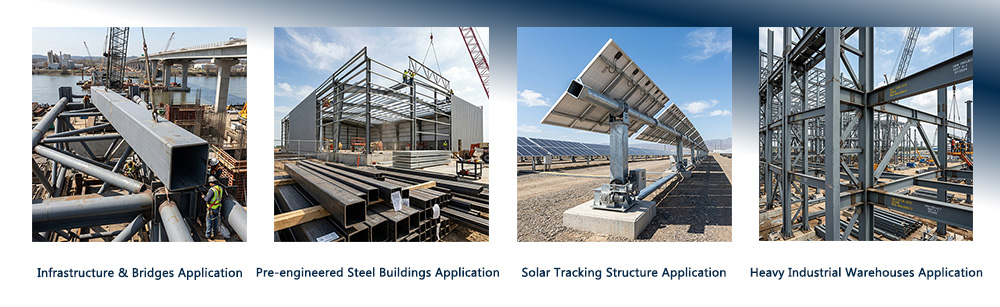
· Procurement Checklist
Before finalizing purchase orders or submittals, purchasing managers should verify the following engineering checklist to ensure alignment with updated specifications:
Standard Designation: Verify that technical data sheets or project submittals align with the updated GB/T 6728-2025 framework.
Steel Grade Specification: Confirm exact grade sub-categories and impact testing designations (e.g., Q355B vs. Q355D) based on temperature constraints.
Dimensional Tolerances: Cross-check Appendix B thickness thresholds against your project’s licensed structural engineer’s requirements.
Galvanizing Compliance: Ensure that hot-dip galvanized coating re-inspection parameters conform to the updated Section 8.3 clauses for outdoor applications.
Traceability & Audits: Verify whether the supplier provides robust batch-tracing mechanisms to simplify project quality audits.
· Frequently Asked Questions
Q1: Is the old GB/T 6728-2017 standard still valid for active sourcing?
A:If project specifications require compliance with the previous GB/T 6728-2017 standard, this should be clearly specified in advance during inquiry or contract stages. Otherwise, production is carried out in accordance with GB/T 6728-2025.
Q2: Can EN 10219 fully replace GB/T 6728-2025 in engineering design?
A: Engineering equivalency between GB/T 6728-2025 and EN 10219 requires formal verification by the project’s structural engineer to ensure compliance with local design codes and loading conditions.
Q3: Is Chinese steel grade Q355B exactly equal to European grade S355?
A: They are highly comparable in nominal yield strength, but slight variances exist regarding chemical composition limits, impact toughness requirements at specific service temperatures, and standardized certification methodologies. Final material selection and compliance requirements should be determined based on project specifications and applicable design codes.
Q4: Does GB/T 6728-2025 cover hot-finished structural hollow sections?
A: No. GB/T 6728-2025 applies specifically to cold-formed welded hollow sections. Hot-finished structural profiles fall under entirely separate national standards.
· Supplier Capability
When selecting structural hollow section manufacturing partners under the GB/T 6728-2025 framework, purchasing managers should evaluate the following vendor criteria:
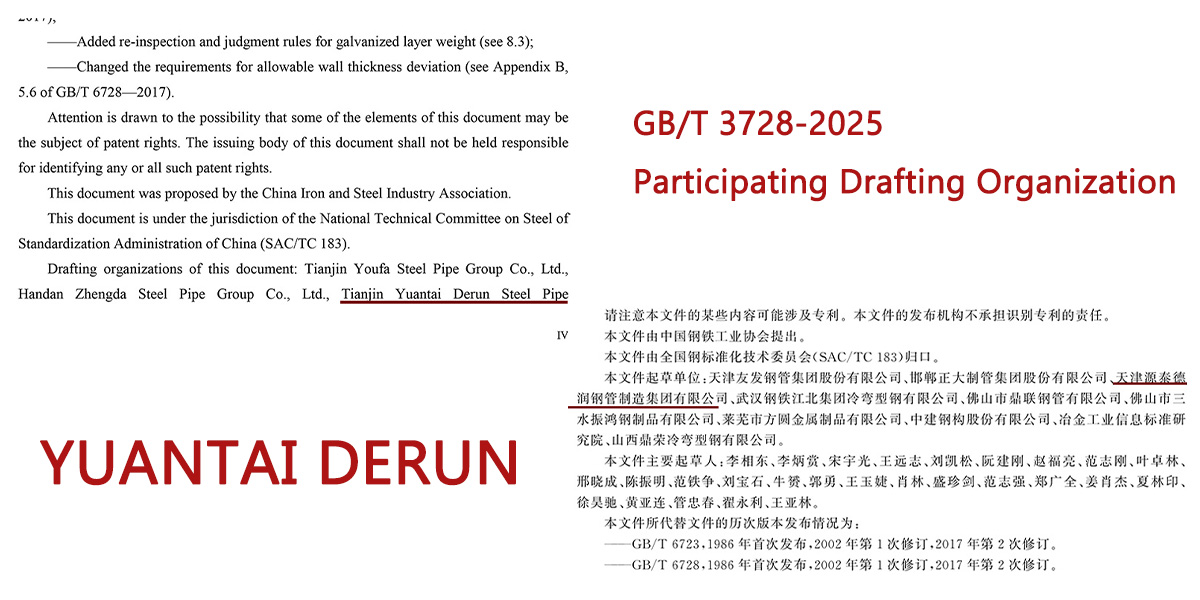
Standard Participation: Has the manufacturer been involved in technical discussions related to national hollow section standards?
Production Capability: Can the mill handle heavy-gauge, large-scale cold-forming requirements without compromising geometric consistency?
Traceability Systems: Does the supplier provide robust batch verification tools to simplify site audits?
Inspection Resources: Are in-house destructive and non-destructive testing capabilities fully certified?
Structural hollow sections are manufactured in compliance with GB/T 6728-2025, supported by internal quality control systems and batch traceability for international EPC applications. As an active participant in the drafting and technical discussions of Chinese national structural steel standards, Tianjin Yuantai Derun Pipe Manufacturing Group ensures that its square, rectangular, and circular cold-formed welded profiles strictly fulfill the premium quality, precise testing, and tolerance thresholds established under the updated GB/T 6728-2025 framework.
· Technical Support
Technical documentation, material equivalency analysis, and standard interpretation support are available upon request for project-specific requirements.
[ ✉️ Request Project-Specific Technical Documentation & Support ]
⚠️ Technical Disclaimer: While technical parameters, standard cross-references, and certified material profiles are provided for reference purposes, we do not provide structural engineering calculations for specific project designs. Final structural verification, load-bearing simulations, and application safety approvals must be executed exclusively by the project’s licensed Professional Engineer.
Post time: Jun-23-2026


