


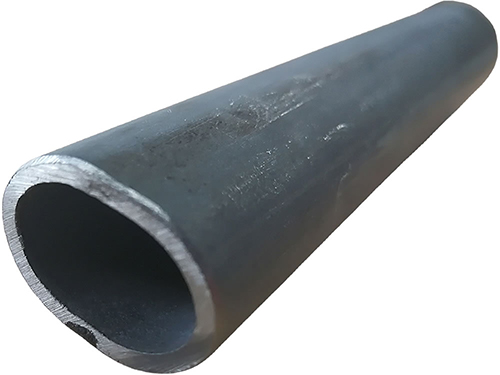
Oval steel pipe is a hollow steel tube featuring an oval-shaped cross section. Engineers often use it when a project requires controlled strength in one direction, smooth edges, and a clean appearance. Compared with round or square pipes, the oval shape alters load distribution and in-service structural behavior.
Section Shape and Strength Behavior
An oval steel pipe has two main dimensions: a long axis and a short axis. Because these two axes are different, the pipe does not behave the same in all directions.
A pipe resists bending better than a round pipe of the same weight when a force is applied along its long axis. This allows engineers to place strength where it is actually needed. When force is applied along the short axis, the bending resistance is lower, so the pipe must be installed in the correct orientation.
Unlike square or rectangular tubes, oval pipes have no sharp corners. Stress spreads more evenly along the curved surface. This reduces the risk of cracking and improves fatigue performance under repeated loading.
Load Performance in Daily Applications
Under compression or light impact, oval steel pipes deform in a more controlled way. Corners are a common weak point in square tubes, but oval pipes avoid this problem.
This makes them suitable for handrails, guardrails, frames, and structures that experience vibration or frequent human contact. The smooth shape also improves safety and comfort during use.
Manufacturing Process
Most oval steel pipes are made from welded steel tubes.And YUANTAI DERUN provides custom oval steel tubing.
Steel strip is first formed into a round tube and welded using electric resistance welding (ERW). After the weld seam is flattened and inspected, the round tube is passed through forming rollers that gradually change its shape into an oval.
During this process, several factors must be controlled:
The size of the long and short axes
Wall thickness after forming
Straightness along the pipe length
Position of the weld seam
Poor control can cause uneven thickness or surface distortion. A stable forming process is necessary to keep the shape consistent from batch to batch.
Material Selection
Low-carbon structural steel is the most common material for oval steel pipes.
As we all know grades such as Q235 or ASTM A500 are widely used because they are easy to form and have stable strength. High strength grades like Q355 or S355 can also be used, but they require stricter forming control.
For outdoor or humid environments, hot-dip galvanized oval pipes are often selected. The zinc layer protects the steel surface and slows down corrosion. For indoor or decorative use, pre-galvanized or painted pipes are usually sufficient.
Stainless steel oval pipes are used where corrosion resistance or surface appearance is critical, such as in architectural or interior projects.
Surface Treatment and Service Life
Surface treatment affects more than appearance.
Hot-dip galvanizing provides long-term corrosion protection and is suitable for outdoor structures. Pre-galvanized pipes offer better dimensional consistency and are easier to process, but their corrosion resistance is lower.
Painted or powder-coated surfaces are often used in visible areas. Proper surface cleaning is important to ensure good coating adhesion and long service life.
Typical Applications
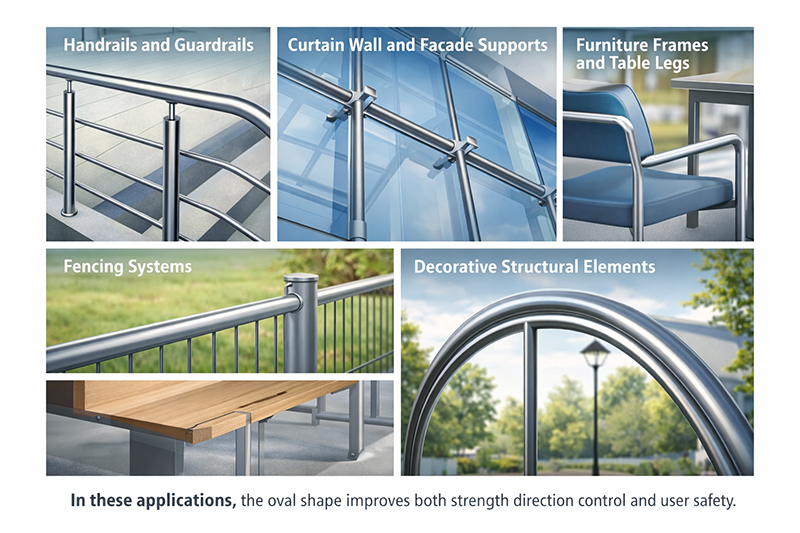
Oval steel pipes are commonly used in:
Handrails and guardrails
Curtain wall and façade supports
Furniture frames and table legs
Fencing systems
Decorative structural elements
In these applications, the oval shape improves both strength direction control and user safety.
Comparison with Other Steel Pipes
Compared with round pipes, oval steel pipes provide higher bending strength in one direction without adding weight. Compared with square or rectangular tubes, they reduce stress concentration and improve fatigue resistance.
However, oval pipes require more precise forming and installation. The orientation of the pipe must match the load direction to achieve the best performance.
Conclusion
Oval steel pipe is a practical structural solution with clear mechanical advantages. Its shape improves stress distribution, safety, and appearance. When produced with proper forming control and used in the correct orientation, oval steel pipes perform reliably in both structural and decorative applications.
Post time: Jan-14-2026


