


Quick Answer: JCOE LSAW pipe is ideal for custom heavy-wall applications because it offers flexible production, accurate dimensions, and reliable weld quality. Unlike traditional UOE production, JCOE can efficiently handle customized diameters, wall thicknesses, and project-based quantities, making it a practical solution for offshore structures, energy pipelines, and heavy construction projects.
Table of Contents
- 1. What Is JCOE LSAW Pipe?
- 2. JCOE vs UOE Pipe: Process Comparison
- 3. Where Are JCOE LSAW Pipes Used?
- 4. How Is LSAW Pipe Made? JCOE Forming Step by Step
- 5. Example Cost Breakdown: A 75-Ton Custom JCOE LSAW Order
- 6. LSAW Pipe Inspection: UT vs RT Testing Requirements
- 7. Pipe Nesting: How to Cut Ocean Freight on LSAW Shipments
- 8. Custom LSAW Pipe RFQ Checklist
- 9. FAQ
- 10. Conclusion
1. What Is JCOE LSAW Pipe?
JCOE LSAW pipe is a longitudinal submerged arc welded steel pipe manufactured by progressively forming a flat steel plate into a cylindrical shape through the J-C-O sequence, followed by full-length mechanical expansion. Unlike spiral welded pipe, LSAW pipe features a single straight longitudinal weld seam, making it suitable for applications requiring high dimensional accuracy and structural reliability.
In offshore structures, energy pipelines, and heavy construction projects, standard pipe sizes are often insufficient. Engineers may require customized outer diameters, heavy wall thicknesses, special steel grades, or specific inspection requirements. For these project-based orders, large-scale UOE production can be less flexible due to its high-volume manufacturing model.
JCOE manufacturing provides greater flexibility for customized dimensions and smaller production batches while maintaining the quality requirements needed for critical applications. Yuantai Derun applies JCOE technology for large-diameter and heavy-wall pipe projects, supporting applications in infrastructure, energy, and structural engineering.
2. JCOE vs UOE Pipe: Process Comparison
Before specifying, it helps to see how the four mainstream processes stack up on the two things buyers actually care about: what geometry they can make, and how small an order they’ll accept.
|
Table 1 — Manufacturing process & commercial flexibility comparison |
||||
|
Technical & Commercial Feature |
JCOE Process (LSAW) |
UOE Process (LSAW) |
ERW Process |
SSAW (Spiral) |
| Forming Mechanism | Progressive step-by-step bending (J-C-O-E) | Single-action U-stamping + O-pressing | Continuous cold roll-forming | Continuous helical coil bending |
| Seam Configuration | Single straight longitudinal seam | Single straight longitudinal seam | Single straight longitudinal seam | Continuous spiral seam |
| Outer Diameter (OD) | 406 mm – 1422 mm (16″ – 56″) | 508 mm – 1422 mm (20″ – 56″) | 21.3 mm – 610 mm (1/2″ – 24″) | 219 mm – 3048 mm (8″ – 120″) |
| Max Wall Thickness (WT) | Up to 50 mm+ (heavy / ultra-heavy) | Optimized for high-volume heavy-wall transmission pipelines (capability varies by mill) | Typically < 20 mm | Typically < 25 mm |
| Tooling Versatility | Universal press dies (flexible) | Dedicated rigid die sets | Fixed sizing roll sets | Adjustable angle forming heads |
| Economic MOQ | Project-based; often suitable for smaller batches depending on mill conditions | 1,000 – 2,000+ Tons | 100+ Tons (coil-dependent) | 100+ Tons |
| Residual Stress Level | Very low after full-length expansion | Low (mechanically expanded) | Depends on forming method & heat treatment | High (complex helical stress) |
Engineer’s take: ERW is great for standard thin-wall lines, and SSAW is widely used for large-diameter applications where spiral welding and project requirements are acceptable. But JCOE LSAW is the process that makes a custom OD, heavy-wall pipe (say OD 720 mm × WT 38 mm) in smaller project-based batches without triggering a five-figure tooling changeover penalty. (See our deeper dive in LSAW vs. SSAW vs. Seamless.)
3. Where Are JCOE LSAW Pipes Used?
Because JCOE handles non-standard diameters and heavy walls in manageable batch sizes, it shows up wherever structural steel needs a precise, certified longitudinal seam. The most common end uses:
- Offshore wind monopiles and transition pieces. Monopiles push 8–12 m in diameter and need consistent wall thickness and roundness; JCOE lets a yard hit exact geometry without a UOE-scale commitment.
- Jacket structures and offshore platforms. Leg sections, braces, and conductor guides call for heavy-wall pipe with tight tolerance — exactly JCOE’s range.
- Oil & gas transmission lines. For sections that need a custom WT or a specific grade near a tie-in, JCOE supplies the piece a spiral mill can’t.
- Heavy structural columns. Stadium roofs, exhibition halls, and industrial frames use large rectangular and circular hollow sections where dimensional control matters more than volume.
In each case the buyer is not shopping for the cheapest ton — they need a pipe that fits the drawing and passes inspection the first time. That is the gap JCOE fills.
4. How Is LSAW Pipe Made? JCOE Forming Step by Step
The name JCOE describes the mechanical sequence used to shape a heavy steel plate:
Steel Plate → J-Bending → C-Bending → O-Bending → ID/OD SAW Welding → Step E (Expansion)
Universal press dies bend the plate step-by-step (J → C → O) — no dedicated tooling required for each size.
- Edge pre-bending: Mechanical crimping shapes the plate edges to the target radius, removing the flat spots that would otherwise sit near the seam.
- J-bending: A universal hydraulic press progressively bends one edge into a “J” profile.
- C-bending: The opposite edge is pressed step-by-step into an open “C”.
- O-bending: The press closes the plate into an open “O”, aligning the edges for submerged-arc welding.
- Submerged Arc Welding (SAW): Multi-wire internal (ID) and external (OD) passes join the seam. High heat input drives deep fusion and burns out potential contaminants.
The Expansion Step (E): Full-Length Mechanical Cold Expansion
The final “E” is expansion. A multi-segment hydraulic expander head travels the full inside length of the pipe, expanding it radially end to end. This is the step that separates JCOE from simple plate-bending shops.
[ Unexpanded welded pipe ] → [ Internal hydraulic expander head ] → [ Improved dimensional consistency and roundness ]
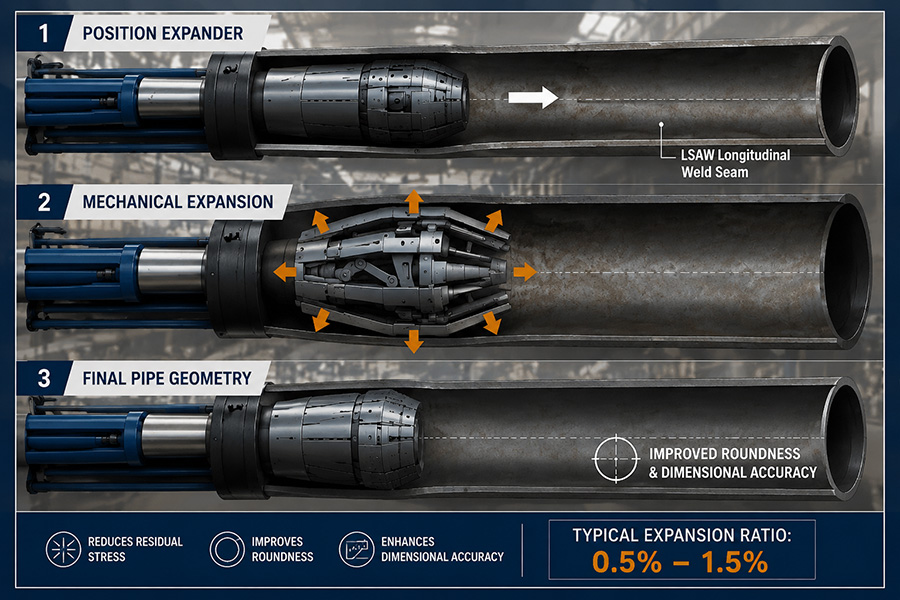
Full-length mechanical expansion relieves residual stress and locks in roundness and straightness along the whole pipe.
- Relieving residual stress: Forming and multi-pass welding leave localized mechanical and thermal stress. Cold expansion yields the steel slightly past its elastic point, relieving residual stress and improving dimensional stability and weld performance consistency.
- Guaranteeing field fit-up: Expansion forces the pipe into strict roundness (ovality) and straightness. Clean pipe ends mean fit-up on site instead of field-welding downtime and alignment fights.
5. Example Cost Breakdown: A 75-Ton Custom JCOE LSAW Order
Note: The figures below are illustrative, based on a representative 75-ton custom batch. Actual pricing depends on steel grade, certification requirements, and incoterms. They are shared to show cost structure, not as a quotation.
Buyers ask us constantly: “Why is the per-ton price higher for a small-batch JCOE order than for a standard bulk run?” The honest answer is a transparent “Three Floors” cost model:
Total Custom Pipe Price = [ Setup & Tooling Floor ] + [ Material Floor ] + [ NRE & Inspection Floor ]
Practical example: project cost allocation
Requirement: API 5L PSL2 X65Q LSAW pipe, OD 610 mm × WT 32 mm (custom heavy wall).
Volume: 75 metric tons (≈ 165 meters / 14 lengths of 11.8 m).
|
Table 2 — 75-ton custom order cost allocation & unit amortization (illustrative) |
|||
|
Cost Component |
Total Line Cost (USD) |
Unit Cost (USD/Ton) |
Amortization Mechanics |
| Raw Steel Plate (X65Q) | $89,200 | $1190 / Ton | Base plate cost ($1,100/t) adjusted for ~7.5% yield loss (pipe-end crop-off, beveling, & test sampling). |
| Setup & Line Calibration | $4,500 | $60 / Ton | Dedicated JCOE press tooling setup, seam-tracker calibration, & test-bending plates. |
| SAW Welding Consumables | $6,000 | $80 / Ton | Multi-pass high-toughness wire, basic flux, & pre-heat/post-weld thermal energy. |
| Hydrotest & Step-E Expansion | $3,750 | $50 / Ton | Full-length mechanical expansion (Step-E) + 100% SMYS hydrostatic test holding. |
| 100% AUT + Pipe-End RT | $4,500 | $60 / Ton | 100% Full-body AUT, pipe-end RT/UT, + MTR 3.1 qualification tests (DWTT/Charpy/HIC if req.). |
| Total Production Cost | $108,000 | $1,440 / Ton | Transparent unit pricing for a 75-ton custom short run. |
Scale insight: Push the order from 75 → 300 tons and the fixed $4,500 setup dilutes from $60/ton to $15/ton. Combined with minor efficiency gains in plate cutting and continuous welding, the unit price eases from $1,440/ton to about $1,385/ton — proof that the “premium” on custom runs is driven by fixed overhead amortization, not inflated profit margins.
6. LSAW Pipe Inspection: UT vs RT Testing Requirements
Procurement teams argue endlessly about whether running both Ultrasonic Testing (UT) and Radiographic Testing (RT) on the longitudinal seam is necessary or just duplicated cost. The short version: they catch different defect classes, so they’re complementary, not redundant.
|
Table 3 — Complementary NDT inspection matrix |
||
|
Inspection Feature |
Ultrasonic Testing (UT / AUT) |
Radiographic Testing (RT / X-Ray) |
| Physical Mechanism | Shear-wave ultrasound probes (2.25 – 5 MHz) | Ionizing X-ray radiation |
| Primary Defect Target | Planar defects: sidewall lack of fusion, vertical cracks | Volumetric defects: gas porosity, slag inclusions |
| Depth Perception | High — pinpoints exact depth in heavy wall | None — 2D top-down shadow projection |
| Inspection Speed | High-speed inline automated scan (100% seam length) | Slower offline test (radiation safety clear zones) |
| Documentation | Electronic digital logs (A-scan / C-scan) | Permanent X-ray film or digital image |
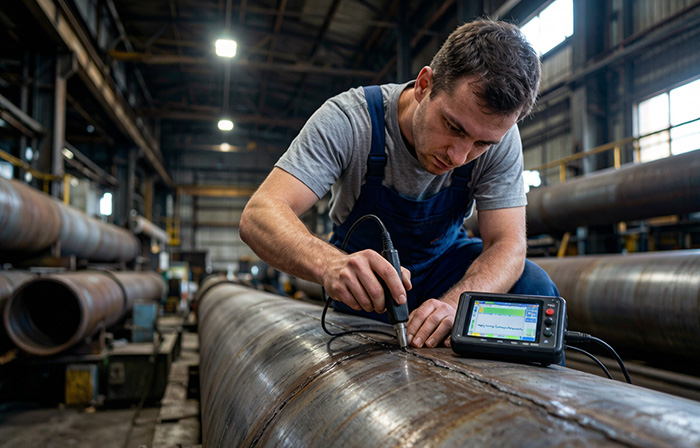
Automated UT scans 100% of the seam length; targeted RT verifies ambiguous signals at the pipe ends.
Why a weld can pass UT but fail RT (and the reverse)
Question we get a lot: ”Can a defect on an LSAW pipe pass UT but fail RT?”
Yes. Micro-cluster porosity or scattered slag lets sound waves pass with minimal reflection (passes UT) yet shows up clearly as voids on X-ray film (fails RT). Flip it around: a tight vertical sidewall crack parallel to the X-ray beam may cast no visible shadow (passes RT) but reflects an ultrasonic beam straight back to the transducer (fails UT). Specifying API 5L PSL2 typically calls for both AUT full-length scanning and spot RT verification, because the standard sets stricter weld-integrity expectations. EN 10219 projects, by contrast, follow the inspection class and purchaser requirements written into the purchase order — which may or may not require the same combination. (Our 100% NDT weld integrity piece covers how to specify either correctly.)
7. Pipe Nesting: How to Cut Ocean Freight on LSAW Shipments
Ocean freight for large-diameter pipe is driven by cargo volume, not weight. Because JCOE makes custom lengths and diameters, you can engineer the shipment to cut landed cost per meter.
[ Pipe nesting / telescoping ] → smaller OD pipe inside larger OD pipe = zero added volume
[ Container optimization ] → custom lengths (5.8 m / 11.8 m) = 100% container volume yield
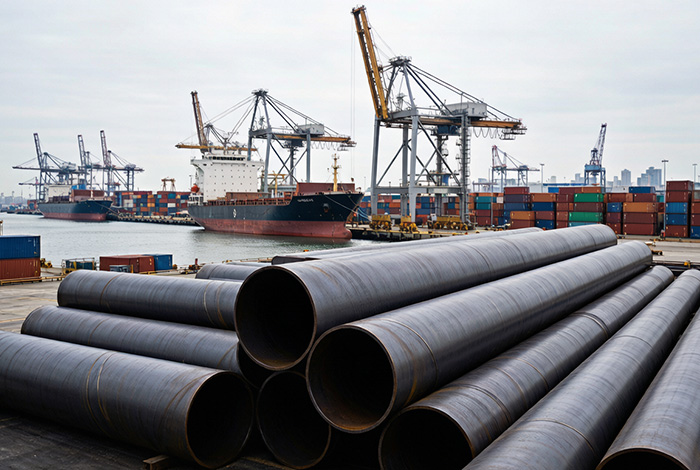
Telescoping a smaller-OD pipe inside a larger one turns free space into saved freight.
Practical savings example: telescoping structural pipes
Outer pipe: OD 1016 mm × WT 25 mm LSAW (100 Tons)
Inner pipe: OD 711 mm × WT 16 mm LSAW (70 Tons)
|
Table 5 — Ocean freight cost comparison (standard vs. nested) |
|||||
|
Shipping Method |
Total Cargo |
Freight Volume (CBM) |
Rate (/CBM) |
Total Ocean Freight |
Freight / Ton |
|
Separate Cargo Shipping |
170 Tons |
280 CBM |
$85 / CBM |
$23,800 |
$140.00 / Ton |
|
Nested (Telescoped) Shipping |
170 Tons |
155 CBM |
$85 / CBM |
$13,175 |
$77.50 / Ton |
|
Net Savings Delivered |
— |
−125 CBM |
— |
−$10,625 |
44.6% reduction |
Custom JCOE lengths can also be cut to container-friendly dimensions (11.8 m for 40HQ boxes) with protective spacers — maxing space yield while keeping pipes from touching in transit.
8. Custom LSAW Pipe RFQ Checklist
To avoid common communication issues during RFQ preparation and get an accurate quote on a custom LSAW order, walk through this checklist:
- Dimensional specs: State exact OD × exact WT in millimeters (e.g., 610 mm × 32 mm). Avoid vague NPS/Schedule calls on heavy-wall items.
- Material grade & delivery condition: Name the grade and state (e.g., API 5L PSL2 X65Q quenched/tempered, or EN 10219 S355J2H normalized).
- Testing & certification: Mandate NDT coverage (100% AUT seam scan + pipe-end RT) and cert level (MTC 3.1, or MTC 3.2 third-party witness by SGS / Lloyd’s).
- End prep & lengths: Bevel angle (30° – 35° for field fit-up) and target lengths (11.8 m ±10 mm for container yield).
Key Takeaways
- JCOE LSAW makes custom OD, heavy-wall pipe (up to 50 mm WT) in smaller project-based batches than a UOE mill typically requires.
- Full-length cold expansion (Step E) relieves residual stress and guarantees field fit-up — fewer welding delays.
- For many API 5L PSL2 critical pipeline applications, automated ultrasonic testing and additional radiographic examination may be specified depending on the applicable specification and purchaser requirements; EN 10219 projects follow their specified inspection class.
- Pipe nesting can cut ocean freight ~45% by shipping smaller-OD pipe inside larger-OD pipe.
9. Frequently Asked Questions (FAQ)
Q1: What is the main difference between UOE and JCOE LSAW pipe manufacturing?
The difference is in the forming mechanics. UOE uses single-action rigid dies to press whole plates into U and O shapes, so it needs massive runs to pay off die changeovers. JCOE uses universal press dies to bend plates progressively (J → C → O), enabling flexible setups suited to custom sizes and smaller batches.
Q2: Why is the per-ton price higher for smaller-batch custom JCOE orders?
Small batches carry fixed baseline costs — machine calibration, test-plate forming, hydrostatic testing, NDT setup — spread over fewer tons. Raw steel mills also add small-run premiums below their standard heat minimums. Those are fixed overhead, not extra margin.
Q3: How does mechanical expansion (Step E) prevent field-welding problems?
Full-length cold expansion forces the pipe into exact diameter, roundness (ovality), and straightness along its whole length. That eliminates joint misalignment at fit-up, saving welder labor and preventing seam cracking.
Q4: Do I need both UT and RT on the seam?
For API 5L PSL2 critical service, generally yes — the standard typically requires both AUT full-length scanning and spot RT. EN 10219 work follows the inspection class written into the purchase order. UT catches planar defects (cracks, lack of fusion) and gives depth; RT catches volumetric defects (porosity, slag).
10. Conclusion
The JCOE process bridges the gap between high-volume mass production and one-off engineering needs. By combining flexible forming, full-length cold expansion, dual-NDT control, and logistics optimization, JCOE gives custom heavy-wall LSAW projects a dependable, cost-effective path — without the large-volume gatekeeping of a UOE mill.
For EPC buyers weighing LSAW vs. SSAW vs. Seamless, or planning offshore-wind and heavy-structure programs, the practical move is to prepare a clear RFQ (use the checklist above) and let the numbers — not the mill’s MOQ policy — decide.
Need Custom LSAW Pipe for Offshore or Infrastructure Projects?
Share your OD, wall thickness, steel grade, and standard requirements with our engineering team. We’ll evaluate production feasibility on our JCOE line and return a technical solution and quote — whether it’s a structural order or a certified transmission-line section.
Figures shown reflect Yuantai Derun’s JCOE/LSAW production experience (API 5L PSL2 / EN 10219) and are for cost-structure reference only. As steel and freight prices fluctuate constantly, please focus on the cost trends. Contact us anytime for a live, custom quote.
Post time: Aug-06-2026


