


ASTM A53 Grade B (also referred to as ASTM A 53 Grade B or A53 GrB) remains one of the most recognized carbon steel pipe specifications worldwide. It is widely used in water transmission, oil and gas, structural piping, mechanical systems, and boiler pipelines.
But when international projects mix standards, buyers inevitably ask:
“What is the ASTM A53 equivalent material in EN, DIN or JIS?”
This guide expands the comparison, introduces equivalent steel grades, explains testing differences, and helps you assess interchangeability when sourcing ASTM A53 steel pipe, seamless pipe, or substitutes.
Understanding ASTM A53 Grade B: Key Characteristics
ASTM A53/A53M covers seamless steel pipe (Type S) and ERW welded pipe (Type E) for general purpose.
✔ ASTM A53 Grade B strength level is medium-high, typically used in fluid transport and pressure-bearing functions.
Chemical Range (ASTM A53 Gr B):
Carbon ≤ 0.30%
Manganese ≤ 1.20%
Phosphorus ≤ 0.05%
Sulfur ≤ 0.045%
Mechanical Properties:
Tensile Strength ≥ 415 MPa
Yield Strength ≥ 240 MPa
Elongation ≥ 20%

ASTM A53 GrB Equivalent Materials in EN, DIN & JIS
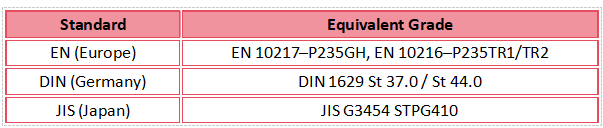
These grades closely match ASTM A53 equivalent materials in terms of strength, carbon composition and elongation properties.
Why They Are Comparable?
EN P235GH → Yield: ~235 MPa, Tensile: 360–500 MPa — almost identical to ASTM A53 Grade B.
JIS STPG410 → Similar carbon level and elongation — ideal for applications demanding pressure resistance and weldability.
Therefore, these materials can generally be considered to ASTM A53 GrB, especially in boiler, structural and pressure pipelines.
ASTM A53 vs ASTM A106 vs API 5L — A Common Buyer Confusion
Many international engineers not only search for “A53 GrB equivalent” but also ask:
✔ “Is ASTM A106 equal to ASTM A53?”
✔ “Is API 5L equivalent to A53 GrB?”
Answer: not exactly.
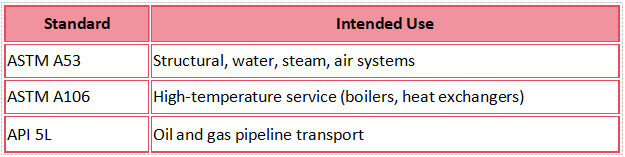
So while ASTM A106 Grade B and API 5L Gr B are often quoted, they are alternative options, not strict equivalencies.
Manufacturing Differences Matter
Even if ASTM A53 equivalent materials match chemically, inspection rules differ:
ASTM A53 Grade B
Hydrostatic test
NDT for weld seams
Bending/flattening test
Covers both ERW and seamless
This is why you’ll frequently see sourcing terms like ASTM A53 ERW steel pipe when specifying welded versions.
EN P235GH / P235TR
Additional impact test requirements
More weld seam documentation
DIN 1629
Stricter dimensional tolerances for seamless pipes
JIS G3454
Performance suitable for boiler and pressure piping applications
How to Validate Equivalency Across Standards?
✔ Compare mechanical and chemical values (±5% tolerance acceptable)
✔ Request MTC or EN/DIN/JIS formatted certificates
✔ Third-party inspection (such as SGS / BV / TÜV) for cross-standard confirmation
This process reduces risk when selecting ASTM A53 equivalent material for global projects.
Why YUANTAI DERUN Is a Reliable ASTM A53 Supplier
With 20+ years of manufacturing experience, YUANTAI DERUN supplies:
✔ ASTM A53 ERW steel pipe
✔ ASTM A53 GrB seamless pipe
✔ EN / DIN / JIS equivalent grade carbon steel pipes
We ensure:
Mill Test Certificate
Chemical, mechanical, hydrostatic, and ultrasonic testing
Standard Certificate
Whether clients specify ASTM A53, ASTM A106, API 5L, or A53 GrB equivalent materials, YUANTAI DERUN provides matching solutions with best service.
Final Thoughts
Comprehending ASTM A53 Grade B equivalent standards is essential for global procurement.
Understanding how ASTM A53 ERW steel pipe compares to European P235GH or Japanese STPG410 helps buyers:
✔ preventing specification errors
✔ reduce certification delays
✔ guaranteeing safety and regulatory adherence
Post time: Dec-05-2025


