


When specifying structural steel hollow sections (SHS/RHS), the distinction between Blow-galvanizing and Hanging-galvanizing is often overlooked. However, for engineers and procurement officers, this choice is the difference between a high-precision component and a heavy-duty industrial asset.
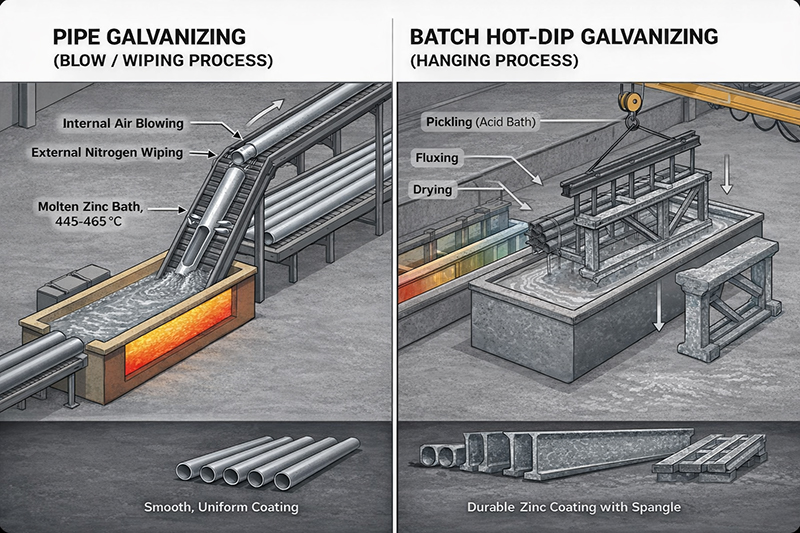
Blow-Galvanizing: The Precision of Pneumatic Uniformity
Blow-galvanizing is an automated, continuous process where tubes are passed through a 450℃ zinc bath and then subjected to high-pressure steam or nitrogen.
Technical Value:
Surface Consistency: The “blow” process removes excess zinc, eliminating “zinc tears” or nodules. This is critical for automated modular construction where every millimeter of clearance matters.
Internal Smoothness: High-pressure internal nozzles ensure the inner walls are smooth and obstruction-free, significantly reducing fluid friction in piping systems.
Tight Tolerances: With a controlled coating mass (typically 300~500g/m2), the external dimensions remain highly predictable, allowing for seamless integration with precision-fit connectors.
Hanging-Galvanizing: The Rugged Metallurgical Shield
Hanging-galvanizing involves suspending tubes on specialized racks for full immersion. This “static” soak allows for a more robust chemical reaction.
Technical Value:
Maximum Thickness: Without the stripping force of high-pressure air, the Zinc layer grows thicker. It easily achieves 85 um to 120um, meeting the rigorous demands of C4/C5 corrosive environments.
R-Angle Reinforcement: In square and rectangular tubes, corners are the traditional “fail points.” Hanging-galvanizing allows zinc to accumulate naturally at the R-angles, providing a thicker barrier where the steel is most vulnerable.
360-Degree Integrity: For tubes with pre-welded plates or complex end-preps, hanging ensures the molten zinc hermetically seals every weld bead and crevice.
Technical Comparison Table
| Feature | Blow-Galvanizing | Hanging-Galvanizing |
| Uniformity | Superior (Internal & External) | Industrial (Heavier at ends) |
| Zinc Thickness | 35-60um |
85-120+ um |
| Surface Finish | Smooth, semi-bright | Textured, matte/industrial |
| Best Application | Precision SHS, Scaffolding | Infrastructure, Marine, Chemical |
| Maintenance | Low (Urban/Rural) | Zero (Heavy Industrial) |
Balancing Accuracy and Durability
The decision hinges on the project’s macro-environment. If the priority is ease of assembly and aesthetic uniformity, blow-galvanizing is the superior choice. However, for infrastructure intended to last 50+ years in harsh climates, the sheer mass and metallurgical “self-healing” properties of hanging-galvanizing provide the lowest total cost of ownership.
FAQ:
Q1: Is blow-galvanized pipe suitable for outdoor solar structures?
While it provides excellent protection, coastal solar farms with high salt spray usually require the thicker coating provided by hanging-galvanizing to prevent premature edge corrosion.
Q2: Why does hanging-galvanized steel feel “rougher”?
The “roughness” is actually the result of the heavy ζ and η layers. While less smooth than blow-galvanized steel, this texture indicates a much thicker, more durable protective shield.
Q3: Does the galvanizing process weaken the structural steel?
At 450℃, the temperature is well below the steel’s critical transformation point. The process actually acts as a mild stress-relief treatment, maintaining the original mechanical properties.
Q4: Can I weld over these tubes easily?
Blow-galvanized tubes are generally preferred for automated welding lines because the lack of zinc nodules ensures a more stable arc and reduces porosity risks.
Post time: Apr-08-2026


