


Introduction
When sourcing structural steel tubes for construction, solar projects, or industrial fabrication, buyers often face a common question: should they choose hot rolled or cold formed steel tubes?
Hot rolled and cold rolled steel tubes may look similar, but their manufacturing processes create significant differences in strength, dimensional accuracy, surface finish, fabrication performance, and cost.
For structural steel projects, choosing the wrong tube type may lead to unnecessary processing costs, welding difficulties, or reduced structural efficiency.
This guide explains the key differences between hot rolled and cold formed steel tubes, including manufacturing processes, mechanical properties, applications, standards, and how to select the right product for your project.
Quick Comparison: Hot Rolled vs Cold Rolled Steel Tubes
|
Feature |
Hot Rolled Steel Tube |
Cold Rolled / Cold Formed Steel Tube |
|
Processing Temperature |
Above recrystallization temperature (around 926°C) |
Room temperature |
|
Manufacturing Method |
Hot forming or hot finishing process |
Cold forming, rolling, and welding |
|
Surface Condition |
Dark oxide scale, rougher surface |
Smooth and uniform surface |
|
Dimensional Accuracy |
Standard tolerance |
Higher precision |
|
Strength |
Good structural strength and ductility |
Higher strength due to work hardening |
|
Residual Stress |
Generally lower |
Higher unless stress relieved |
|
Weldability |
Excellent for structural fabrication |
Good depending on condition |
|
Cost |
Usually more economical for large structures |
Higher due to additional processing |
|
Best Applications |
Buildings, bridges, solar structures, heavy fabrication |
Precision parts and applications requiring tight tolerance |
What Is the Difference Between Hot Rolled and Cold Rolled Steel Tubes?
Although both products are used in steel fabrication, the main difference comes from the forming process.
In structural steel tube manufacturing, “hot rolled” is often associated with hot-finished hollow sections, while many square and rectangular tubes are produced through cold forming from hot rolled steel coils.
The manufacturing method directly affects the tube’s surface condition, dimensional accuracy, residual stress, and final application performance.
Manufacturing Process: How Hot Rolled and Cold Formed Tubes Are Made
Hot Rolled Steel Tubes
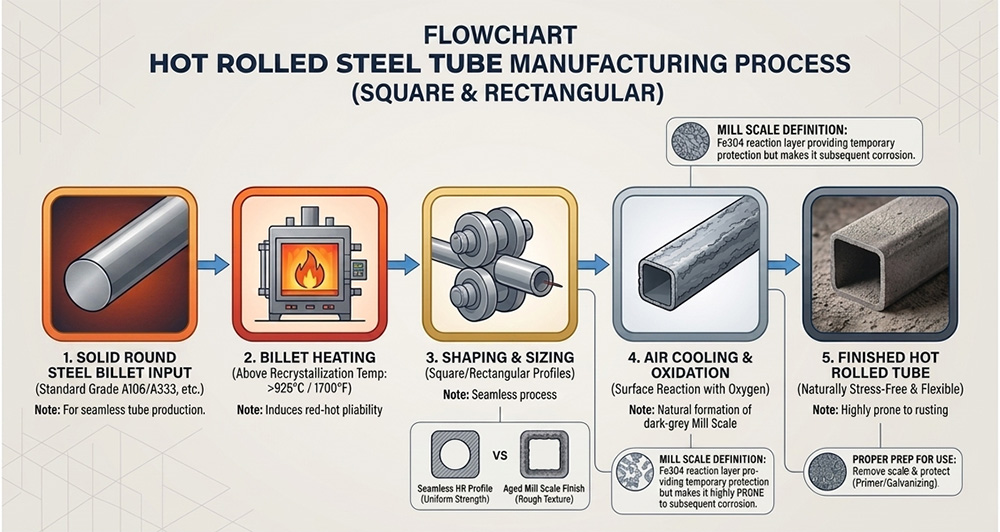
Hot rolled steel tubes are produced at temperatures above the steel recrystallization temperature, normally above 926°C.
At high temperatures, steel becomes softer and easier to deform, allowing manufacturers to produce large sections with good structural stability.
After forming, the steel cools naturally at room temperature. The slow cooling process helps reduce residual stress and provides good ductility and fabrication performance.
Manufacturing Process
Cold Formed Steel Tubes
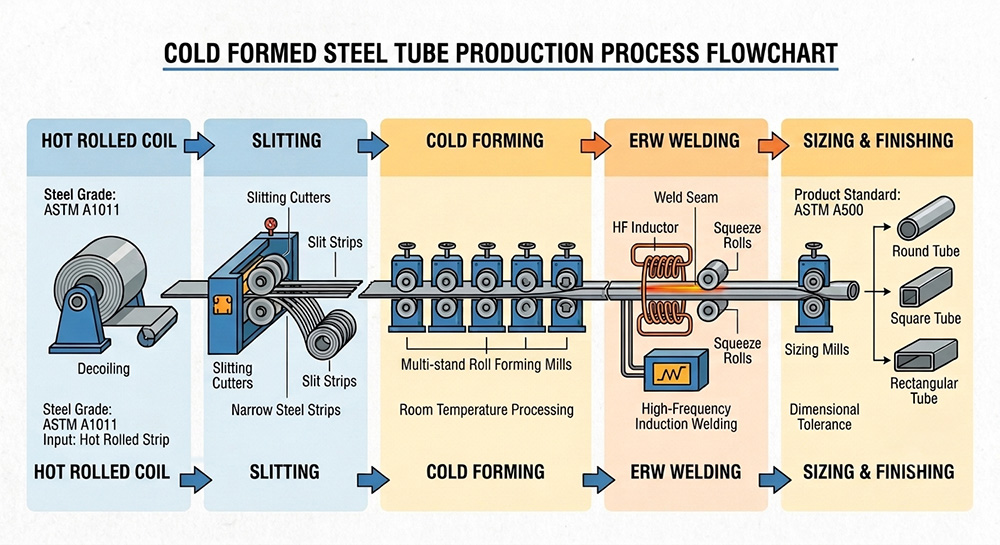
Cold formed steel tubes are produced at room temperature through cold working processes.
For welded square and rectangular tubes, the typical process is:
Surface Finish and Dimensional Accuracy
Surface Appearance
Hot Rolled Steel Tube
During cooling, the hot steel surface reacts with oxygen and forms iron oxide.
This creates a dark gray oxide scale layer, commonly known as mill scale.
Characteristics:
- Dark oxide surface
- Slightly rough texture
- Requires surface preparation before coating
Cold Formed Steel Tube
Because production occurs at room temperature, there is no high-temperature oxidation process.
Characteristics:
- Smooth surface
- Better appearance
- More uniform dimensions
Dimensional Tolerance
Hot rolled steel tubes usually have wider tolerances because cooling shrinkage can create dimensional variation.
Cold formed tubes achieve tighter tolerances because they are processed through precision rollers and dies.
Mechanical Properties Comparison
|
Property |
Hot Rolled / Hot Finished |
Cold Formed |
| Strength | Good structural strength | Higher strength from cold working |
| Ductility | Generally higher | Lower compared with hot rolled |
| Residual Stress | Lower | Higher unless stress relieved |
| Tolerance | Standard | Tighter |
| Surface Finish | Oxide scale | Smooth surface |
| Fabrication | Excellent weldability | Depends on condition |
For structural applications, higher strength does not always mean better performance.
Weldability, ductility, and residual stress control are equally important factors.
Hot Rolled vs Cold Rolled Steel Tubes: Which One Should You Choose?
The best choice depends on project requirements.
|
Project Requirement |
Recommended Choice |
|
Steel buildings and structural frames |
Hot rolled / hot finished |
|
Heavy welding fabrication |
Hot rolled |
|
Solar mounting structures |
Hot rolled + galvanizing |
|
Outdoor structures |
Hot rolled with corrosion protection |
|
Precision mechanical components |
Cold formed |
|
Tight dimensional tolerance |
Cold formed |
Applications of Hot Rolled and Cold Rolled Steel Tubes
Construction and Steel Structures
Hot rolled square and rectangular tubes are widely used in:
- Steel buildings
- Warehouse structures
- Bridges
- Platforms
- Load-bearing structures
Heavy Equipment and Transportation
Common applications include:
- Truck trailers
- Agricultural machinery
- Equipment frames
- Industrial supports
Solar Mounting Structures
Hot rolled structural tubes are commonly selected for utility-scale solar projects because they provide:
- High load capacity
- Long service life
- Good fabrication performance
With hot-dip galvanizing or Zn-Al-Mg coating protection, they provide reliable outdoor corrosion resistance.
Oil & Gas and Infrastructure
Applications include:
- Pipeline supports
- Structural supports
- Industrial facilities
Common Standards and Steel Grades
|
Standard |
Region |
Product Type |
Typical Grades |
|
GB/T 6728 |
China |
Cold formed welded hollow sections |
Q235B, Q355B, Q355D/E |
|
ASTM A500 |
USA |
Cold formed structural tubing |
Grade A/B/C/D |
|
EN10219 |
Europe |
Cold formed welded hollow sections |
S235JRH, S355J2H |
|
EN10210 |
Europe |
Hot finished structural hollow sections |
S275NH, S355NH |
|
JIS G3466 |
Japan |
Structural square and rectangular tubes |
STKR400, STKR490 |
Buying Guide: How to Select the Right Steel Tube Supplier
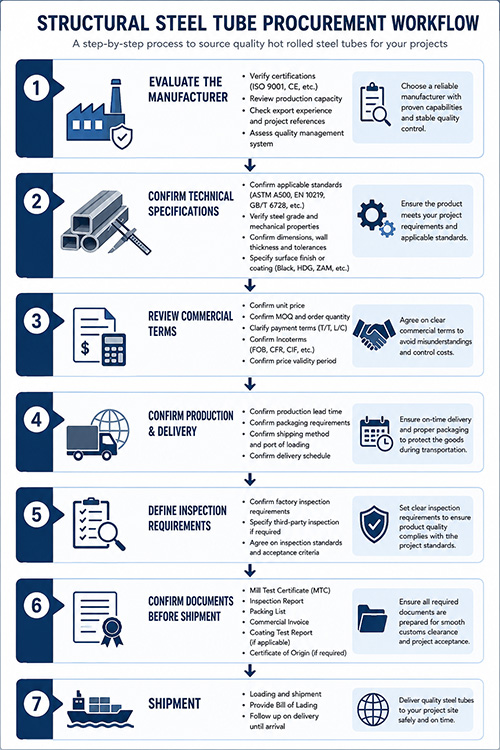
Choosing the correct steel tube is only part of the procurement process.
A reliable manufacturer should also provide stable quality, production capability, inspection support, and delivery reliability.
1. Confirm Technical Requirements
Before ordering, confirm:
- Product standard
- Steel grade
- Tube dimensions
- Wall thickness
- Tolerances
- Surface requirements
2. Verify Manufacturing Capability
Check whether the supplier can provide:
- Required sizes
- Required steel grades
- Production capacity
- Export experience
3. Review Quality Documents
Request:
- Mill Test Certificate (MTC)
- Chemical composition
- Mechanical properties
- Inspection reports
4. Confirm Delivery and Inspection
Consider:
- Production lead time
- Packaging
- Shipping method
- Third-party inspection requirements
Why Global Buyers Choose Yuantai Derun
With more than 20 years of experience in structural steel tube manufacturing, Yuantai Derun supplies square, rectangular, and round hollow sections for global construction, infrastructure, renewable energy, and industrial projects.
✓ ASTM A500 / EN10219 / EN10210 compliant production
✓ Large-scale manufacturing capacity
✓ Mill Test Certificate support
✓ Third-party inspection support
✓ Global export experience
Frequently Asked Questions
Q1. Will hot rolled steel tubes rust?
A:Yes. Hot rolled steel is unprotected carbon steel and will rust when exposed to moisture and oxygen.For outdoor applications, surface preparation and protective coatings such as painting or hot-dip galvanizing are recommended.
Q2. Is ASTM A36 the same as hot rolled steel?
A:No.ASTM A36 defines the chemical composition and mechanical requirements of steel, while hot rolled describes the manufacturing process.
Q3. Can hot rolled steel tubes be bent?
A:Yes.Hot rolled tubes generally have better ductility and lower residual stress, making them suitable for many bending and fabrication processes.
Q4. What is the difference between EN10210 and EN10219?
A:EN10210 applies to hot-finished structural hollow sections.EN10219 applies to cold-formed welded structural hollow sections.
Q5. Are hot rolled tubes stronger than cold formed tubes?
A:Not always.Cold forming can increase strength through work hardening, while hot rolled tubes usually provide better ductility and lower residual stress.
Post time: Jul-17-2026


