


When it comes to modern steel pipe manufacturing, ERW (Electric Resistance Welding) and HFW (High-Frequency Welding) are two of the most common and efficient production methods.While they might appear identical at first glance, ERW and HFW steel pipes vary considerably in their welding methods, quality benchmarks, and application scopes. Understanding the difference between ERW and HFW steel pipes is essential for choosing the appropriate material for your project.
What Is ERW Pipe?
ERW (Electric Resistance Welding) pipes are made by rolling a steel coil into a cylindrical or square shape and then joining the edges by applying electrical current and mechanical pressure.
The heat produced by electrical resistance at the seam causes the steel edges to melt and merge, creating a continuous, solid weld.
ERW pipes are known for:
Strong dimensional precision
Consistent wall thickness
Cost efficiency for large-scale production
These pipes are widely used in water supply systems, low-pressure piping, and general structural applications.
What Is HFW Pipe?
HFW (High-Frequency Welding) pipe is a type of ERW pipe that uses high-frequency current (above 100 kHz) to heat and weld the steel edges.
In contrast to traditional ERW, which may rely on low-frequency current, HFW applies a focused, high-intensity heat to a limited area, ensuring a smaller heat-affected zone (HAZ) and superior weld integrity.
The process includes:
1.Shaping the steel strip into the required form (round, square, or rectangular).
2. Heating the edges via induction using a high-frequency current.
3.Pressure welding the heated edges to form a smooth, seamless joint.
HFW technology enables cleaner, more accurate welds with minimal oxidation , making it well-suited for high-strength structural steel tubes and precision square pipe.
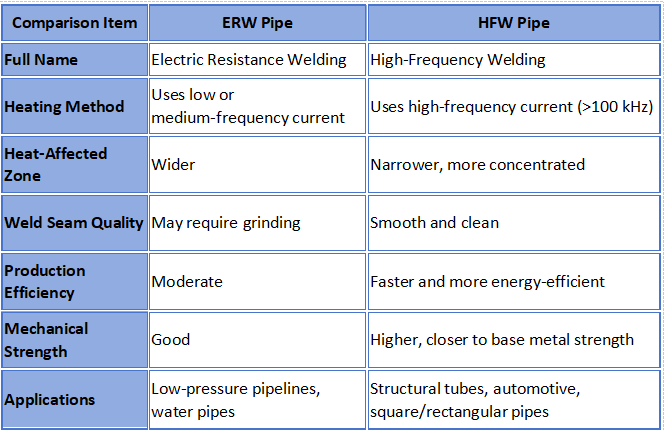
Main Differences Between ERW and HFW Pipes
Technical Explanation
While both ERW and HFW rely on electrical resistance to produce heat, the specific current and frequency significantly influence the process.
ERW Welding Principle:
Low-frequency current flows through the steel strip, creating heat along the joint through resistance. The heated edges are then forced together to form a solid bond.
HFW Welding Principle:
Uses high-frequency induction to create intense, concentrated heat directly along the weld line. This yields a superior, more polished weld with very little material distortion.
Essentially, HFW represents a more sophisticated evolution of ERW, engineered to enhance weld integrity, production speed, and overall operational efficiency.
Applications of ERW and HFW Pipes
Both ERW and HFW pipes are used in a wide range of industries, but their applications differ depending on performance needs.
ERW Steel Pipes:
Water and gas pipelines
Scaffolding and fencing
Low-pressure transportation systems
General engineering structures
HFW Steel Pipes:
Steel structure and building frames
Square and rectangular hollow sections
Automotive and machinery manufacturing
Greenhouses, furniture, and precision construction
Since HFW pipes can achieve high weld strength and dimensional accuracy, they are often preferred in modern construction and mechanical engineering applications.
Surface Treatment Options
Both ERW and HFW pipes are available in different surface finishes:
Black (untreated): Natural dark surface, used for indoor or non-corrosive environments.
Hot-dip galvanized: Zinc coating offers enhanced corrosion resistance ,ideal for outdoor or water-exposed ssytems.
Pre-painted or powder-coated: Used for aesthetic appeal or to provide extra protection against rust.
Tianjin Yuantai Derun Group, supply both black HFW square pipes and galvanized steel tubes to meet diverse application requirements.
For projects that call for high-strength structural tubing or precision square pipes, selecting HFW welded pipes will ensure a longer service life and better performance than conventional ERW pipes.
FAQ
Q1: Can HFW steel pipes completely replace traditional ERW pipes in all structural projects?
A: While HFW pipes offer superior weld integrity, a smaller heat-affected zone (HAZ), and higher precision for demanding structural applications (such as square/rectangular hollow sections and heavy machinery), traditional ERW pipes remain a cost-effective and reliable choice for low-pressure fluid transport, general fencing, and light structural frameworks. The choice depends on your specific engineering load and project budget.
Q2: How does Yuantai Derun ensure the weld quality of its HFW and ERW steel tubes?
A: Quality is strictly controlled at every stage. Tianjin Yuantai Derun employs advanced online Non-Destructive Testing (NDT) systems, including ultrasonic testing (UT) and eddy current testing, to detect and eliminate any weld defects. All products adhere strictly to international standards like ASTM A500, ASTM A53, and EN 10219, backed by official MTC 3.1 test reports.
Q3: What trade terms and surface finishes does Yuantai Derun support for global buyers?
A: We offer flexible commercial terms including EXW, FOB, CFR, and CIF (excluding DDP). For surface treatments, our ERW and HFW tubes are available in black (untreated with anti-rust oil), hot-dip galvanized (HDG) for ultimate outdoor corrosion resistance, and pre-painted finishes tailored to your custom specifications.
Q4: What are the main factors causing wall thickness tolerance differences in ERW and HFW pipes?
A: Wall thickness tolerance is primarily determined by the precision of the forming rolls, strip steel raw material consistency, and online monitoring systems. Advanced HFW production lines utilize high-precision roller adjustments and real-time laser/ultrasonic feedback loops to maintain strict adherence to international standards like EN 10219 and ASTM A500, preventing dangerous negative tolerances.
Q5: How does Yuantai Derun handle packaging and protection for overseas shipments of steel tubes?
A: Protection and packaging are customized based on specific client requirements and optional processing services (which involve corresponding processing fees). Depending on your needs, we can apply anti-rust oil, bundle tubes securely with heavy-duty steel strips, wrap them in waterproof woven plastic fabrics or moisture-resistant paper, and arrange specialized nested loading (small tubes inside large tubes) to optimize container space and reduce shipping costs.
Q6: What is the typical lead time for standard HFW square and rectangular hollow sections?
A: For standard dimensions and regular steel grades (such as S275 or S355 in EN 10219), our massive production capacity at Yuantai Derun allows us to ship from ready stock or complete rolling production within 15 to 25 days. Custom dimensions or special coating requirements may require a slightly adjusted schedule depending on mill availability.
Post time: Nov-07-2025


