



If you are a solar EPC contractor or procurement manager buying structural steel hollow sections from China, you need to update your specification sheets right now. As of March 1, 2026, China’s cold-formed steel industry officially rolled out the new GB/T 6728-2025 standard, completely replacing the old 2017 version.
For solar tracker and pylon procurement, executing quality audits against this updated standard is a necessary risk-mitigation step to safeguard long-term structural integrity throughout the project’s lifecycle.
Before we dive into the specific risks for solar trackers, you might want to check out our quick breakdown of the general technical changes on our news page: GB/T 6728-2025 Update: Key Changes & Impacts for Steel Hollow Sections.
1. Automated Laser Cutting: Reducing Springback Risks
Modern solar tracker manufacturing increasingly relies on automated laser cutting and precision punching. However, cold-formed sections with high residual stresses may experience distortion or “springback” after slotting and cutting, leading to dimensional deviations and assembly difficulties.
GB/T 6728-2025 established refined requirements for dimensional accuracy and straightness control, particularly through the strict geometric benchmarks specified in Clause 6.1 (Cross-sectional Dimensions) and Clause 6.3 (Straightness). While the standard focuses on finished-product compliance rather than internal stress limits, these geometric requirements encourage manufacturers to improve roll-forming consistency and overall process control.
For EPC contractors and solar tracker manufacturers, selecting sections produced in accordance with GB/T 6728-2025 can help improve dimensional stability during downstream processing, reduce fabrication risks, and support more reliable automated assembly.
2. Straightness: Keeping Tracker Motors from Jamming
Solar tracking systems rely on high-precision geometric alignment. If your steel hollow sections have even a slight twist or bend over a long span, it creates massive mechanical resistance for the drive motors. Over time, this burning out your gearboxes.
The 2025 framework tightens up the tolerances for straightness and cross-sectional twist. It gives structural engineers exactly what they expect, ensuring smooth, low-friction tracker rotation even under heavy wind loads.
Key Upgrades for Solar Steel Structures
| Metric | Legacy 2017 Framework | GB/T 6728-2025 Focus | Potential Benefit |
| Dimensional Accuracy | General dimensional control | Clause 6.1 & 6.3: Strieter geometric requirements | Better assembly consistency |
| Straightness & Twist | Standard tolerance control | Clause 6.3: Enhanced straightness / twist limits | Alleviates tracker motor binding risks |
| Process Consistency | Varies by manufacturer | High consistency required for 6.1/6.3 compliance | Predictable stability; limits laser slotting springback |
| Substrate & Surface | Basic baseline verification | Clause 6.5.3 & 6.11: Rigorous raw material & defect control | Ensures a more uniform and adherent coating application |


3. Corrosion Control: Surface Quality and Coating Verification
Solar arrays are fully exposed to diverse and often corrosive atmospheric environments, making reliable Hot-Dip Galvanizing or Zinc-Aluminum-Magnesium coatings essential for long-term durability.
While coating performance and coating weight requirements are typically specified by project specifications or dedicated coating standards, GB/T 6728-2025 places greater emphasis on product consistency, dimensional quality, and surface condition. Improved manufacturing control can contribute to more uniform coating application and better overall product reliability for outdoor structural applications.
Quality Inspection Advisory: When utilizing non-destructive coating thickness gauges for site or port inspections, QC teams should ensure that measurements are taken away from cut edges or sheared ends. Mechanical deformation from sawing or cutting operations may affect local readings, leading to inaccurate coating thickness results. Standard practice requires measurements on flat, undisturbed surface areas to ensure reliable coating verification in field installation environments.
4. Mill Test Certificate (MTC): Material Traceability and Verification
The Mill Test Certificate serves as the definitive legal and technical document verifying material traceability and structural integrity. Under the GB/T 6728-2025 framework, MTC compliance paths are strictly bifurcated depending on the geometry of the profile to ensure accurate manufacturing oversight.
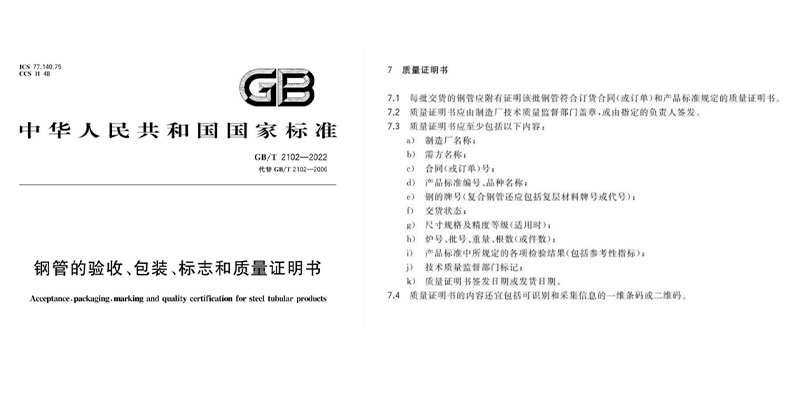
As explicitly mandated in Clause 9.5 of the standard :
Closed Hollow Sections: The MTC must strictly comply with the comprehensive provisions of GB/T 2102.
Open Profiles: The MTC must conform to the requirements of GB/T 2101.

Mandatory Data Fields for Full Material Traceability
For structural square, rectangular, and circular hollow sections widely deployed as main torque tubes or tracker components, the MTC data fields must strictly satisfy the rigorous quality control protocols of GB/T 2102. In addition to standard physical dimensions, the verification records must highlight:
a) Name of the manufacturing mill;
b) Name of the purchaser;
c) Contract (or purchase order) number;
d) Product standard number and variety name;
e) Steel grade/designation (for cladding/composite steel tubes, it shall also include the cladding material grade or code);
f) Delivery state / condition;
g) Dimensional specifications and accuracy tier/level (when applicable);
h) Heat number, batch number, weight, and number of pieces (or count of parts);
i) All inspection and test results specified in the product standard (including reference indicators);
j) Mark/stamp of the technical quality supervision department;
k) Issuance date of the quality certificate or the product dispatch date.
7.4 The content of the quality certificate should also preferably include a 1D barcode or QR code capable of information identification and data capture.
Certification Requirements for Open Profiles (GB/T 2101 Compliance)
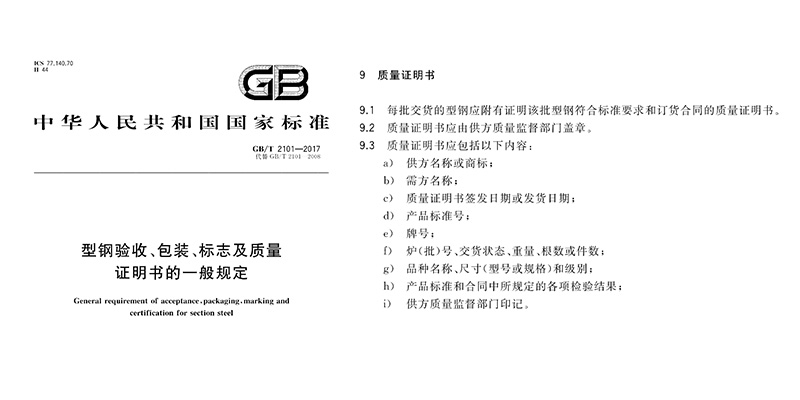
For foundation piles, structural channels, C-channels, or purlins fabricated as open sections, the MTC must mirror the exact regulatory sequence specified in Clause 9.3 of GB/T 2101 (as shown in the reference standard layout). Every valid certification must officially carry the authorized stamp of the supplier’s quality supervision department and contain the following sequential entries:
a) Supplier Verification: Name or registered trademark of the supplier.
b) Purchaser Identification: Official name of the procuring entity/purchaser.
c) Execution Chronology: Official date of MTC issuance or actual product dispatch date.
d) Regulatory Anchor: The specific product standard number executed during manufacturing.
e) Metallurgical Designation: Precise steel grade or designation.
f) Batch Logistics: Heat (batch) number, official delivery state, total weight, and exact piece or bundle count.
g) Dimensional & Structural Class: Product variety name, precise cross-sectional dimensions (model/specification), and quality classification grade.
h) Contractual & Testing Compliance: All actual inspection and test results required by the executed product standard and purchasing contract agreements—including ladle chemical analysis (C, Si, Mn, P, S) and structural test indicators.
i) Endorsement Seal: The official validation stamp or mark of the supplier’s technical quality supervision department.
Engineering Oversight Note: > For utility-scale solar EPC contractors managing vast structural tracker portfolios, mandating this strict bifurcation in material data verification is a critical risk-mitigation step. Enforcing exact alignment with GB/T 2102 for closed sections and GB/T 2101 (Clause 9.3) for open sections guarantees an unbroken, legally defensible traceability chain from the initial metallurgical melt to final site delivery.
5. FAQ: Quick Answers for Solar Buyers
Q1: Can I still order the old 2017 standard for new contracts?
A: Honestly, no. The 2017 version is officially obsolete. Using outdated standards for new projects creates massive insurance and legal compliance headaches for international EPCs.
Q2: Do you provide structural wind or load calculations for customized tubes?
A: As a manufacturer, we provide complete technical data sheets, steel chemistry, and manufacturing limits. However, for custom orders, we provide technical data but will not provide structural calculations. Your own licensed project engineers must validate the final wind and snow load calculations.
Q3: How should we measure wall thickness to avoid disputes?
A: Always measure away from the cut edge. Cutting tools deform the steel right at the lip. Measuring a few inches away from the edge gives you the true, legally binding thickness under the new standard.
6.Conclusion
Relying on the legacy 2017 framework introduces avoidable mechanical and corrosion risks to long-span solar tracking infrastructures. Partnering with a Tier-1 manufacturer that actively participated in the drafting and formulation of the updated GB/T 6728-2025 standard (like YUANTAI DERUN) is the most definitive path to securing supply chain integrity and ensuring absolute field compliance.
If you need a copy of the new guidelines, drop us a line or visit our portal to download the official GB/T 6728-2025 PDF reference guides.
Post time: Jun-29-2026


